
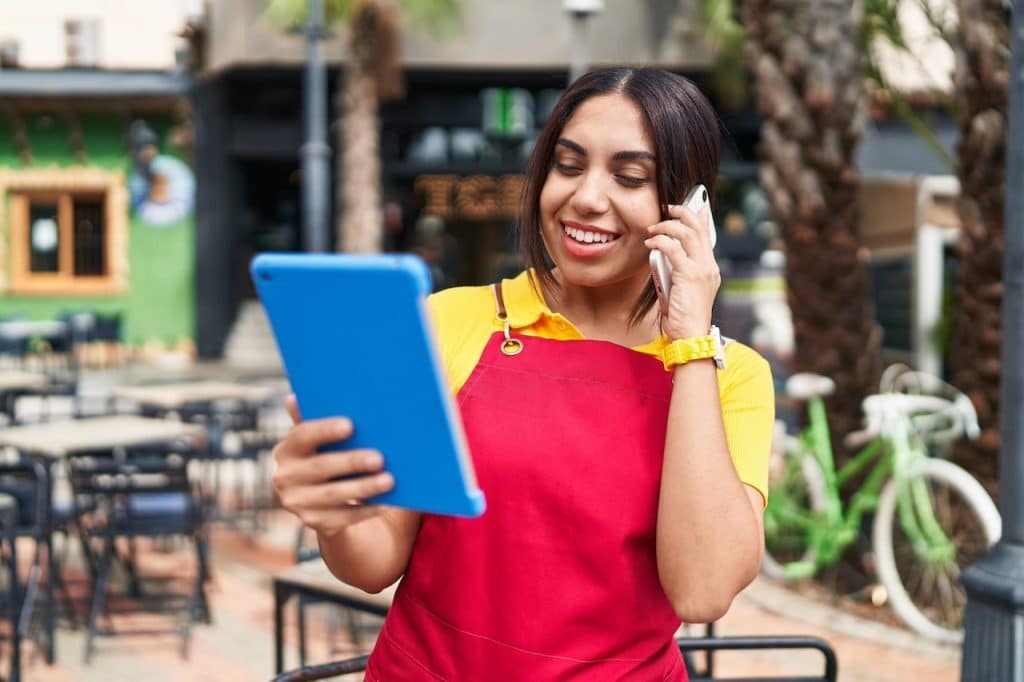
Opening a restaurant or café in Seychelles comes with plenty of expenses before the first customer walks through the door. Rent, kitchen equipment, refrigeration, staff, ingredients, licensing and utilities can quickly consume a new operator’s capital. A point-of-sale system is another expense that many owners assume they simply have to accept.
That is not necessarily the case.
A small restaurant, takeaway business, coffee shop or café in Seychelles can start with a free cloud-based POS and avoid adding another monthly software bill to the cost of doing business. One option worth considering is Slant POS, which currently offers a free plan for businesses processing up to 100 orders per month. The free plan includes restaurant-focused functions such as order and menu management, takeaway and dine-in management, analytics, inventory, recipes, kitchen display, loyalty, promotions and QR-code ordering.
For a Seychelles restaurant that is still building its customer base, that can make a meaningful difference.
The important part is understanding what “free POS” actually means, how to set one up, what hardware you need, and how payments fit into the picture.
What Does a Free POS Mean in Seychelles?
A free POS generally means that you do not pay a recurring software subscription for the basic POS service. It does not necessarily mean that operating the entire checkout system costs nothing.
You may still have expenses for:
- A tablet or POS terminal
- Receipt printer
- Cash drawer
- Internet connection
- Barcode scanner, if needed
- Payment terminal
- Merchant account
- Card processing fees
- Online payment fees
- Optional POS features above the free plan
That distinction matters.
For example, Slant POS pricing currently lists a Free Forever plan covering up to 100 orders per month. Its paid plan is available when a business grows beyond the free allowance or needs additional capacity.
So the goal is not necessarily to find a checkout system where every component is free. The more realistic goal is to eliminate the monthly POS software cost while keeping control of the other parts of the operation.
Why a Cloud POS Makes Sense for a Seychelles Restaurant
A cloud POS is particularly useful for an owner who does not want to be tied to a traditional back-office computer.
With a cloud system, sales and operational information can be accessed through supported internet-connected devices. Slant describes its POS as cloud-based, with access through devices and browsers as well as Android tablets or Android POS hardware.
That can be useful in Seychelles for an owner who wants to check the business without standing behind the counter all day.
Imagine owning a small café in Victoria. You may be buying supplies, meeting a supplier, dealing with staff or simply taking a day away from the shop. A cloud POS can allow you to check sales and other business information remotely rather than waiting until you return to the restaurant.
It also avoids the traditional model where the restaurant’s information lives exclusively on one computer inside the premises.
Step 1: Decide Whether You Actually Need a POS
Before signing up for anything, determine what your business needs.
A small coffee kiosk selling five drinks may not need the same setup as a 60-seat restaurant in Mahé. A takeaway restaurant may care more about fast order entry than table management. A full-service restaurant may need table transfers, split bills and kitchen order tickets.
For most restaurants and cafés, however, a POS becomes useful surprisingly quickly.
At a minimum, you want to be able to:
- Enter orders accurately
- Record cash sales
- Record card or electronic payments
- Issue receipts
- Track daily sales
- Manage your menu
- Review sales reports
- Control user access
- Keep sales records
- Monitor inventory where appropriate
Slant is designed specifically around restaurant operations and lists features including billing, kitchen order ticketing, table management, inventory management, reporting, loyalty, promotions, QR-code ordering and multi-location management.
That is considerably different from using a generic cash register or spreadsheet.
Step 2: Check Your Seychelles Licensing Requirements
Getting free POS software does not replace the legal requirements for operating a restaurant or café.
The Seychelles Licensing Authority provides separate licensing information for restaurants and cafés. Its current restaurant guidance lists a five-year restaurant licence fee of SCR 1,500, while its café licence page lists SCR 1,200 for five years. The exact licensing requirements depend on the type of business and premises.
Restaurant applicants may also need evidence relating to business registration, premises ownership or lease, public health approval, and planning or occupancy requirements where applicable.
The Seychelles Licensing Authority also says that business licence applications can involve inspections by agencies including Planning, Public Health, Tourism, Fire Safety and other relevant authorities, depending on the activity and premises.
This is worth emphasizing because a free POS only solves one part of starting the business.
Your software budget may be zero, but you still need to budget properly for licensing, equipment, rent, staff, food, utilities and compliance.
Step 3: Create Your Free Slant POS Account
Once you have established that a cloud POS suits your operation, the next step is straightforward.
Go to Slant POS and create an account.
The current free plan is advertised as “Free Forever” for up to 100 orders per month. It includes core restaurant functions rather than offering only a stripped-down cash register.
When creating the account, use the actual business details you intend to use operationally. It is better to build the system properly from the beginning than to create a temporary test account and later have to reconstruct your restaurant.
Set up:
- Business name
- Restaurant or café location
- Currency
- Tax settings where applicable
- Staff accounts
- Menu categories
- Menu items
- Prices
- Dining options
- Payment types
- Receipt information
Take your time with the menu.
A badly configured menu creates problems at the till, in the kitchen and in your sales reports.
Step 4: Build the Menu Properly
Do not simply enter “Coffee – SCR 60” and stop there if your business needs more detailed inventory tracking.
A café might have:
- Espresso
- Americano
- Cappuccino
- Latte
- Iced coffee
- Tea
- Smoothies
- Sandwiches
- Pastries
- Cakes
- Bottled drinks
A restaurant may have dozens or hundreds of items.
If you use inventory and recipe management, ingredients can be associated with menu items so that the POS becomes more useful for understanding food costs and consumption.
Slant’s free plan currently lists inventory management and recipe management among its included features.
That is one of the reasons a restaurant-specific POS can be more useful than a simple free cash-register application.
Step 5: Set Up Your Tables and Order Types
If you operate a full-service restaurant, configure your tables and floor plan.
You may want separate areas for:
- Indoor tables
- Outdoor seating
- Bar seating
- Takeaway
- Delivery
- Counter orders
Slant supports table management, including moving items between tables and viewing table occupancy and revenue information.
For a café with mostly counter service, you may not need elaborate table management at all.
That is an important point: do not configure features simply because they exist.
A busy café benefits from simplicity. If staff have to click through six screens to sell a cappuccino, the software is working against the business.
Step 6: Connect Your Kitchen Workflow
A restaurant POS should reduce communication problems between the front counter and kitchen.
Slant includes Kitchen Display System functionality and kitchen order ticket management.
For example, a customer orders:
- Grilled fish
- Fries
- Salad
- Fresh juice
The order can move into the kitchen workflow rather than relying on a waiter shouting the order across the room or carrying handwritten notes.
For a small café, this may be less important. For a busy restaurant, it can become one of the most valuable parts of the POS.
Step 7: Use the Hardware You Already Have
The software may be free, but hardware is where new owners often overspend.
You do not necessarily need an expensive proprietary POS terminal.
A compatible Android tablet can potentially serve as the front-of-house POS device. Slant states that its cloud software can be accessed through supported devices and browsers and through its app on Android tablets or Android POS devices.
A basic setup might therefore consist of:
- Android tablet
- Receipt printer
- Cash drawer
- Internet connection
- Separate payment terminal
If you already own a suitable tablet, your initial POS hardware cost can be considerably lower.
Do not buy hardware before confirming compatibility. A cheap printer that cannot communicate properly with the POS is not a bargain.
Step 8: Keep Your Payment Processor Separate From Your POS
This is one of the most important considerations for a Seychelles restaurant.
A restaurant owner should not assume that choosing a POS means choosing the payment processor at the same time.
Ideally, your POS records the sale while your payment provider handles the actual payment transaction.
That gives the restaurant more flexibility when deciding how customers should pay.
For example, a restaurant might accept:
- Cash
- Visa
- Mastercard
- Bank transfer
- Payment links
- Other locally supported electronic payment methods
Seychelles Commercial Bank, for example, offers merchant POS services and describes its POS terminals as supporting card transactions, while merchant acquiring involves a merchant service charge on card transactions.
Absa Seychelles also offers merchant payment solutions, including physical POS machines and e-commerce payment services. Its e-commerce service describes acceptance of international cards including Visa, Mastercard and American Express.
The key lesson is that you should choose payment processing based on your business needs, rates, settlement arrangements, supported cards and local availability—not simply because the processor happens to be bundled with a POS.
With Slant, the company’s website specifically describes a model where customers can pay from a payment terminal without requiring the POS to be physically in hand.
In practical terms, a Seychelles restaurant should discuss its preferred payment arrangement with the bank or payment provider and separately confirm the POS workflow and compatibility.
That separation can be valuable because it reduces the risk of being locked into one payment provider.
Step 9: Configure VAT and Receipts Correctly
Tax configuration deserves attention before you start selling.
The Seychelles Revenue Commission says VAT-registered businesses collect VAT on taxable supplies at the point of sale and that VAT charged should be shown separately on invoices and receipts. The current compulsory VAT registration threshold is SCR 2 million in taxable supplies, with voluntary registration rules also applying below that threshold.
Do not simply guess the tax settings inside your POS.
Confirm your business’s actual VAT status and applicable tax treatment with the Seychelles Revenue Commission or your accountant, then configure the POS accordingly.
A free POS that produces incorrect receipts is not saving you money.
Step 10: Test Everything Before Opening
Run several test transactions before the first real customer arrives.
Test:
- Cash sales
- Card sales
- Refunds
- Discounts
- Voids
- Split bills
- Takeaway orders
- Dine-in orders
- Kitchen tickets
- Receipt printing
- End-of-day reports
- Inventory deductions
- Staff logins
Then deliberately make a mistake.
For example, enter the wrong item and see how quickly your cashier can correct it.
Restaurant POS problems usually appear during busy service, when there is no time to read a manual.
What Happens When You Exceed 100 Orders?
This is the main limitation a growing Seychelles restaurant needs to understand.
Slant’s current free plan is limited to 100 orders per month.
For a small café or new restaurant, that may be enough to get started. But 100 orders can disappear quickly.
If your café averages five orders per day, you are nowhere near the limit. If you average 20 orders every day, you will exceed it.
That is not necessarily a problem.
The free plan can effectively become a way to launch the business, learn the system and establish your operating procedures. When sales grow, you can decide whether the additional capacity justifies moving to a paid plan.
Slant POS currently lists its paid plan at $32 per month per outlet when billed annually, although pricing should always be confirmed before purchasing.
Is a Free POS Really Free?
For the software subscription, it can be.
But restaurant owners should think about total cost of ownership, not just the monthly subscription.
Suppose your POS software costs SCR 0 per month, but you spend thousands of rupees on unnecessary hardware or accept expensive payment processing. You have not actually optimized the operation.
A better approach is to keep each cost under control independently:
POS software: Free where the business qualifies.
Hardware: Buy only what the operation needs.
Internet: Choose a reliable connection and have a backup plan.
Payments: Compare merchant service charges and settlement terms.
Accounting: Maintain accurate sales and tax records.
Staff: Train employees before launch.
That is how a genuinely low-cost POS setup should be approached.
Why Slant POS Is a Strong Option for Seychelles
For a small Seychelles restaurant or café, Slant stands out because its free plan is built around restaurant operations rather than being simply a generic register.
The current free offering includes cloud POS, menu and order management, dine-in and takeaway management, analytics, inventory, recipes, kitchen display, loyalty, promotions and QR-code menu/online ordering, subject to the plan’s limits.
The broader platform also supports restaurants, cafés, bakeries, food trucks, dessert shops and other food businesses.
That makes it a practical starting point for an independent operator who wants more than a basic till but does not want to commit to a large POS bill on day one.
The biggest advantage is arguably the combination of low software cost and operational depth.
A restaurant owner can start small, configure the system around the actual business, and upgrade when the business has enough sales to justify it.
The Best Free POS Strategy for a New Seychelles Café
If I were setting up a small café in Seychelles on a tight budget, I would keep the initial POS setup simple.
Start with Slant’s free plan.
Use an existing compatible Android tablet if available.
Add a basic receipt printer only if printed receipts are required or useful for the operation.
Use a separate payment terminal or merchant service selected according to the café’s needs.
Configure the menu carefully.
Set up staff permissions.
Track inventory for expensive or high-volume ingredients.
Run daily sales reports.
And keep the payment processor relationship separate from the POS decision wherever the technical setup allows it.
That approach gives the owner more control over the business and makes it easier to change payment providers later if rates, service or customer preferences change.
Final Thoughts
A restaurant or café in Seychelles does not necessarily need to spend a large amount of money on POS software before opening.
A free cloud-based system can handle many of the core functions a small food business needs, while a separate payment processor can handle the actual customer transaction. Slant POS currently offers a Free Forever plan for up to 100 orders per month, with restaurant-specific tools that go well beyond simple sales entry.
The smart approach is to treat the POS as part of the restaurant’s operating system, not simply as a cash register.
Get the licensing right. Configure taxes correctly. Build the menu carefully. Use affordable hardware. Train staff. Test the payment process. And, importantly, do not assume that your POS provider needs to be your payment processor.
For a new café, takeaway operation or small restaurant in Seychelles, that combination can provide a surprisingly capable technology setup without adding another monthly software expense before the business has established itself.


