
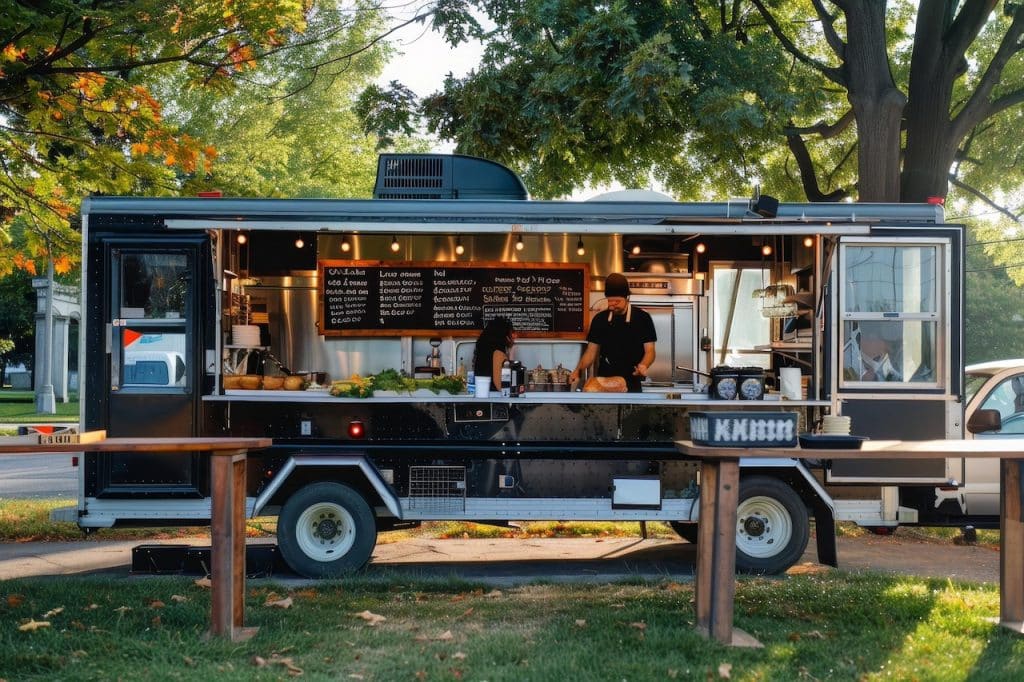
Choosing the right generator is one of the most important decisions when building or buying a food truck. Your generator supplies the electricity that keeps refrigeration, ventilation, lighting, air conditioning, pumps, POS equipment, small appliances, and sometimes the cooking equipment running throughout the day.
Get the generator right and it becomes something you rarely think about. Get it wrong and you can spend service wondering when the next breaker will trip, whether the refrigerator will stay cold, or whether the air conditioner will shut down during the lunch rush.
The challenge is that there is no single generator that is right for every food truck. A coffee trailer has a very different electrical requirement from a burger truck. A taco truck using propane cooking equipment may need considerably less generator capacity than an all-electric mobile kitchen.
The right way to choose a food truck generator is to start with your equipment, calculate your electrical demand, account for startup loads, and then choose a generator with enough capacity to handle normal operations without constantly running at its limit.
How Much Generator Power Does a Food Truck Need?
Food truck generators commonly fall somewhere between approximately 5,000 and 12,000 watts, although smaller operations may require less and heavily electrified kitchens may require considerably more.
A rough planning guide looks like this:
| Food Truck Type | Approximate Generator Size |
|---|---|
| Small coffee or snack trailer | 3,000–5,000 watts |
| Small propane-powered food truck | 5,000–7,000 watts |
| Typical mixed-use food truck | 7,000–10,000 watts |
| Larger commercial food truck | 10,000–15,000 watts |
| Heavily electric food truck | 15,000–20,000+ watts |
These numbers should not be treated as a substitute for calculating the actual electrical load of your truck.
For example, a small coffee truck might have a refrigerator, espresso machine, coffee grinder, blender, water pump, lighting, POS system, Wi-Fi equipment, and air conditioning. Depending on the equipment selected, that operation could have very different power requirements from another coffee truck with a different espresso machine and HVAC system.
A burger truck using a propane griddle and fryer may need substantial electrical power for refrigeration, exhaust, HVAC, lighting, POS, and small appliances, but propane removes much of the cooking load from the generator.
An all-electric food truck is another matter. Electric fryers, induction cooktops, ovens, griddles and other commercial cooking equipment can consume thousands of watts each.
Start With Your Food Truck Equipment
Do not buy a generator first and then try to make your food truck fit its capacity.
Start by creating a complete equipment list.
Write down every item that will consume electricity, including equipment that may seem insignificant. A food truck’s electrical load can include:
- Refrigerator
- Freezer
- Ice machine
- Exhaust hood
- HVAC or roof air conditioner
- Water pump
- Water heater
- Espresso machine
- Coffee grinder
- Blender
- Microwave
- Food processor
- Electric fryer
- Electric griddle
- Induction burner
- Oven
- Lighting
- POS terminal
- Payment terminal
- Router and Wi-Fi equipment
- Speakers
- Battery chargers
Then find the actual electrical specifications for each appliance.
Look at the manufacturer’s documentation or equipment plate for voltage, amperage, running watts, and starting watts where applicable.
This is much more accurate than relying on a generic online wattage chart.
Running Watts vs. Starting Watts
One of the most important concepts in generator sizing is the difference between running watts and starting watts.
Running watts are the amount of electricity equipment normally requires while operating.
Starting watts are the additional power some equipment needs when it first turns on.
Motors and compressors are particularly important. Refrigerators, freezers, air conditioners, pumps, and ice machines can require a temporary surge when their motors start.
That means a generator that appears large enough based only on the running load may still overload when several pieces of equipment start at the same time.
For example, imagine that your food truck has a normal running load of 6,000 watts. If the air conditioner and refrigeration equipment create substantial startup demand, a 6,000-watt generator may not provide enough capacity.
This is why generator sizing should account for both continuous demand and startup requirements.
Calculate Your Maximum Food Truck Load
A simple worksheet can make generator selection much easier.
Create four columns:
Equipment | Running Watts | Starting Watts | Used During Service?
Then enter every electrical appliance.
Next, determine which pieces of equipment are likely to operate simultaneously.
You do not necessarily need to add every appliance together at its maximum possible load. A blender that runs for 30 seconds every few minutes does not necessarily represent the same continuous demand as an electric fryer running throughout lunch.
At the same time, do not underestimate your peak demand.
A busy lunch service may involve refrigeration, HVAC, exhaust ventilation, lighting, POS equipment, pumps, cooking appliances, and several small appliances operating at the same time.
Once you calculate the maximum realistic load, choose a generator with additional capacity rather than planning to operate continuously at its absolute limit.
Why Food Truck Owners Should Consider Propane Cooking
The cooking method has a major impact on generator size.
Propane cooking can significantly reduce the electrical demand of a food truck.
A propane griddle, fryer, range, or other cooking equipment does not draw thousands of watts from the generator in the same way that electric cooking equipment does.
This leaves the generator primarily responsible for refrigeration, HVAC, exhaust, lighting, water pumps, POS equipment, and smaller appliances.
This can allow a food truck to operate with a smaller generator.
For example, a taco truck using propane burners and a propane griddle may have a completely different generator requirement from a burger concept using an electric griddle and electric fryer.
If you are still designing your truck, decide on the cooking fuel before finalizing the generator.
Changing from propane cooking to electric cooking later can dramatically increase the electrical requirements of the truck.
What Is the Quietest Generator for a Food Truck?
Generator noise matters more on a food truck than it does in many other applications.
A construction crew can tolerate a noisy generator because the generator is not part of the customer experience. A food truck parked at a farmers market, brewery, office complex, festival, or food truck park has a different problem.
Customers may be standing a few feet away from the generator.
A loud generator can make conversations difficult, interfere with music, disturb neighboring vendors, and create complaints from nearby businesses or residents.
This is why many food truck operators look at inverter generators.
Inverter generators are generally quieter than traditional open-frame generators, particularly when operating at lower loads. They can adjust engine speed based on demand rather than continuously running the engine at full speed.
One example is the Honda EU7000iS. Honda lists it with 5,500 rated watts and 7,000 maximum watts, with published noise levels of approximately 52 dB(A) at one-quarter load and 58 dB(A) at rated load.
Another option in the larger portable category is the Champion 8500-watt tri-fuel inverter generator, which has a published noise rating of 64 dB(A).
The important lesson is to compare the actual manufacturer’s noise specifications rather than assuming a generator is quiet because the product description uses words such as “silent” or “quiet.”
Also check the conditions under which the noise measurement was taken. A generator running at 25% load will generally produce a different sound level from the same generator operating near maximum capacity.
Best Generators for Food Trucks
There is no single best generator for every food truck.
Instead, the best generator is the one that matches the truck’s electrical requirements, physical layout, fuel strategy, operating environment, and budget.
For a small coffee trailer, a compact inverter generator may be appropriate if the electrical load is relatively low.
For a propane-powered taco, barbecue, or burger truck, a generator in the 5,000- to 8,000-watt class may provide sufficient capacity for refrigeration, HVAC, ventilation, pumps, lighting, POS, and other electrical equipment.
A larger truck with multiple refrigeration units and significant HVAC requirements may need an 8,000- to 12,000-watt generator.
An all-electric food truck can require considerably more.
When comparing generators, look at the rated or continuous output rather than focusing only on the largest number in the product advertisement.
A generator advertised as producing 10,000 watts may have a lower continuous operating rating.
For a commercial food truck, the continuous rating is the number that matters most.
Inverter Generator vs. Conventional Generator
For many food truck applications, an inverter generator is worth considering.
Inverter generators can provide stable power for sensitive electronics, including POS systems, payment terminals, routers, tablets, and other electronic equipment.
They also tend to be quieter than conventional open-frame generators.
Traditional generators can still make sense when high output and lower purchase cost are more important than noise and portability.
However, food truck owners should remember that their generator operates in a customer-facing environment.
A generator designed primarily for construction use may be perfectly capable of producing electricity but still be a poor fit for a food truck because of noise, size, weight, or fuel consumption.
Gasoline vs. Propane vs. Dual-Fuel Generators
Fuel choice should be considered alongside the truck’s cooking system.
Gasoline generators are widely available and can be convenient for mobile operations. Gasoline is easy to find in most areas, although fuel storage and refueling need to be managed properly.
Propane generators can make sense for food trucks that already use propane for cooking. Depending on the generator and installation, the same general fuel infrastructure may make propane a convenient option.
Dual-fuel generators provide the ability to use gasoline or propane. This flexibility can be valuable when operating in different locations.
Tri-fuel generators add natural gas as another fuel option. They can be useful in some applications, although natural gas is less practical for many mobile food truck environments.
One important detail is that generator output can change depending on the fuel.
For example, a generator may produce more running watts on gasoline than propane. Always check the manufacturer’s specifications for the fuel you actually plan to use.
Do You Need a 120-Volt or 240-Volt Generator?
Generator capacity is not just about watts.
You also need to make sure the generator produces the correct voltage and amperage for your food truck.
Many food trucks use 120-volt equipment, while some commercial equipment requires 240 volts.
Before purchasing a generator, check:
- Voltage requirements
- Amperage requirements
- Plug configuration
- Receptacle type
- Breaker requirements
- Generator inlet
- Shore-power connection
- Grounding requirements
- Electrical panel configuration
If your food truck requires 240-volt equipment, buying a generator that only provides the necessary 120-volt configuration will not solve the problem even if the advertised wattage appears sufficient.
Have the generator and electrical system reviewed by a qualified electrician or food truck builder before installation.
Generator Runtime Matters
A food truck may operate for eight, ten, or more hours on a busy day.
Generator runtime therefore matters.
Do not simply look for the generator with the largest fuel tank. Look at the manufacturer’s runtime specifications and the load at which those figures were measured.
A generator advertised to run for 12 hours at 25% load may run substantially less when your food truck is pulling 70% or 80% of its capacity.
Consider how much fuel you will consume during a normal operating day.
Also think about where the generator will be refueled and how fuel will be transported and stored. Fuel management becomes especially important for operators attending events where the truck may be away from its normal base for an entire day.
How Important Is Generator Weight?
Food truck owners sometimes focus so heavily on wattage that they forget the generator has to physically go somewhere.
Large generators can weigh hundreds of pounds.
That matters if the generator is being moved manually, transported in a service vehicle, stored between events, or installed as part of the truck.
Weight also matters when designing the truck itself.
A permanently installed generator needs to be incorporated into the vehicle design. Its weight, location, ventilation, service access, and exhaust routing all need to be considered.
Do not choose a generator simply because it fits the electrical requirements. Make sure it fits the truck.
Generator Placement and Ventilation
Generator placement is a safety issue, not merely a convenience issue.
Never operate a fuel-burning generator inside the food truck or inside an enclosed compartment unless it has been specifically designed and professionally installed for that purpose.
Generators produce carbon monoxide and other exhaust gases.
The generator needs adequate ventilation and must be positioned so exhaust cannot enter the truck through doors, windows, vents, or other openings.
Carbon monoxide protection features can provide an additional safety measure, but they do not replace proper generator placement and ventilation.
The manufacturer’s installation and operating instructions should always take priority.
Consider Food Truck Noise Restrictions
Before buying a generator, check the locations where you expect to operate.
A generator that works perfectly at one location may create problems at another.
Food truck parks, festivals, shopping centers, breweries, office complexes, municipalities, and private events can have their own noise requirements.
If your business will regularly operate near residential areas or other vendors, a quieter generator can make the operating environment considerably more pleasant.
The generator should also be positioned as far from customers and neighboring businesses as practical while still meeting safety and ventilation requirements.
Should You Buy One Large Generator or Two Smaller Generators?
Some food truck businesses may benefit from having two generators rather than one.
Two smaller units can provide redundancy and flexibility. Certain generator models can also be connected using approved parallel kits to increase available power.
For example, compatible Honda EU7000iS generators can be paralleled to provide additional output.
But two generators also mean additional maintenance, fuel management, storage requirements, and equipment costs.
For most new operators, the simpler solution is to determine the actual load and install an appropriately sized system.
Redundancy becomes more interesting for larger operations where losing electrical power could result in significant product loss or service disruption.
Can a Portable Power Station Replace a Food Truck Generator?
Battery power stations are becoming more capable, and they can be useful for certain food truck applications.
They are particularly attractive for low-power equipment such as:
- POS terminals
- Tablets
- Wi-Fi equipment
- LED lighting
- Small refrigeration loads
- Phone chargers
- Small electronics
The major limitation is energy capacity.
Large electric fryers, ovens, HVAC systems, induction cooktops, and other high-draw equipment can consume battery capacity rapidly.
A battery system also needs an inverter capable of handling the equipment’s starting and continuous power requirements.
For that reason, battery power is better viewed as another tool rather than a universal replacement for a generator.
Some food truck businesses may eventually use a combination of generator and battery power, particularly when reducing noise is important.
Food Truck Generator Maintenance
Your generator is business-critical equipment, so maintenance should be part of the operating routine.
Follow the manufacturer’s maintenance schedule for:
- Engine oil
- Oil filters
- Air filters
- Spark plugs
- Fuel filters
- Battery
- Cooling system
- Fuel system
- Electrical connections
- Tires or wheels
- Exhaust system
Do not wait until the generator fails during Saturday’s lunch rush to discover that it needs maintenance.
Keep records of operating hours and maintenance.
It is also worth periodically testing the generator under a realistic electrical load. A generator that starts easily without a load may behave differently when the refrigerator, HVAC, pumps, and other equipment are all operating.
Common Food Truck Generator Mistakes
Buying based only on advertised maximum watts: The maximum output is not the same as the continuous rated output.
Ignoring startup surges: Refrigeration and HVAC equipment can require additional power when motors start.
Using generic wattage estimates: Check the actual specifications for your equipment.
Buying too small: Constant overloads can create operational problems and shorten equipment life.
Buying unnecessarily large: An oversized generator adds weight, cost, fuel consumption, and installation complexity.
Ignoring noise: Your customers and neighboring businesses will hear it.
Forgetting propane output: Check the generator’s specifications for the fuel you actually intend to use.
Ignoring voltage: Some commercial appliances require 240 volts.
Improper installation: Generator connections, grounding, ventilation, and exhaust routing should be handled correctly.
Forgetting backup planning: A generator failure during service can shut down the entire business.
Food Truck Generator Buying Checklist
Before purchasing a generator, make sure you can answer these questions:
- What is the total running wattage?
- What equipment has a startup surge?
- What is the maximum realistic simultaneous load?
- How much reserve capacity do I want?
- Are the appliances 120 volts, 240 volts, or both?
- Will the truck use propane, gasoline, or another fuel?
- What output does the generator provide on that fuel?
- How quiet does the generator need to be?
- How long must it operate between refueling?
- Where will the generator be located?
- How much does it weigh?
- Does it physically fit the truck?
- How will it be secured?
- How will it be ventilated?
- How will exhaust be directed?
- What maintenance will it require?
- Does the installation comply with applicable local requirements?
- What happens if the generator fails during service?
If you can answer those questions before buying, you are much less likely to end up with an expensive generator that does not work for your business.
Final Thoughts: Choosing the Right Food Truck Generator
The right food truck generator starts with the menu.
Your cooking method, refrigeration requirements, HVAC system, equipment choices, operating schedule, and locations all influence the generator you need.
A small coffee trailer may be able to operate comfortably with a relatively compact inverter generator. A propane-powered taco or barbecue truck may need a larger unit to handle refrigeration, ventilation, HVAC, pumps, and technology. A food truck built around electric fryers, griddles, ovens, and induction equipment can require dramatically more power.
Do not choose the generator by looking for the biggest number on the box.
Calculate the actual load. Account for startup demand. Check voltage and amperage. Leave reasonable headroom. Compare noise levels. Consider fuel availability and runtime. Make sure the generator physically fits the truck. And have the electrical installation reviewed by a qualified professional.
The generator should support the food truck rather than dictate what the food truck can do.
For an aspiring food truck owner, that means choosing the generator after the equipment plan is established—not before. When the generator is correctly sized and properly installed, it gives you something every food truck operator needs during a busy service: confidence that the kitchen will keep running.


