
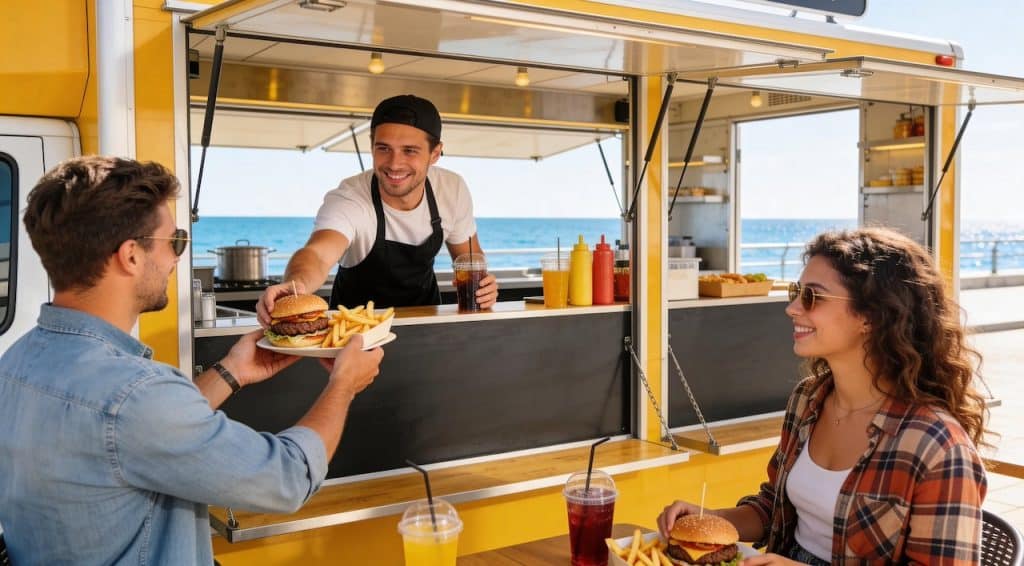
Digital marketing has become one of the most important ways for food truck owners to attract customers, build a recognizable brand, promote daily locations, and generate repeat business. Unlike a traditional restaurant, a food truck does not have the advantage of a permanent storefront that customers can see every day. The truck may be at an office park for lunch, a brewery in the evening, a festival on Saturday, and somewhere completely different the following week.
That mobility creates a unique marketing challenge: customers need to know not only what you sell, but also where and when they can find you.
For that reason, food truck marketing should be built around local search, social media, location announcements, online reviews, digital ordering, customer retention, catering, and targeted advertising. The objective is not simply to accumulate followers. It is to turn online attention into people standing at the service window, placing orders, booking catering, and returning on a regular basis.
The following digital marketing strategies provide a practical framework for food truck owners who want to build a stronger online presence and generate more business from it.
Build a Strong Digital Foundation
Before investing in advertising or spending hours creating social media content, make sure customers can find accurate information about your business.
At a minimum, a food truck should have a mobile-friendly website, a Google Business Profile, an online menu, active social media profiles, current contact information, a reliable location schedule, and a way for customers to place an order or request catering.
The website does not need to be complicated. A simple food truck website can be more effective than an elaborate restaurant-style site if it answers the questions customers actually have.
Visitors should be able to quickly find:
- The food truck’s name and cuisine
- Current menu
- Prices
- Today’s location
- Weekly schedule
- Operating hours
- Online ordering information
- Catering information
- Phone number or contact form
- Social media profiles
- Customer reviews or testimonials
The location schedule deserves particular attention. For a food truck, location is part of the product.
Someone searching for a burger restaurant may be willing to visit a particular address. Someone searching for a burger truck may only have 30 minutes before returning to work. If the customer cannot determine where the truck is operating, the marketing has failed regardless of how attractive the website or social media page looks.
Make Local SEO a Priority
Local SEO is particularly important for food trucks because customers frequently search for food based on their immediate location.
Searches such as “food trucks near me,” “taco truck near me,” “lunch food truck,” and “[cuisine] food truck in [city]” indicate strong local intent.
Food truck owners should therefore build their online presence around the geographic areas they genuinely serve rather than attempting to rank for generic national keywords.
Your website can include useful information about your operating area, regular neighborhoods, catering coverage, events, and schedule. If you regularly serve several communities, location-specific content can help potential customers understand where they can find you.
The important point is accuracy. Do not create pages for cities or neighborhoods where the truck does not actually operate simply to capture search traffic.
A food truck’s SEO strategy should reflect the real operating business.
Optimize Your Google Business Profile
Google Business Profile is one of the most important free digital marketing tools available to a local food business. It can help customers discover the truck through Google Search and Google Maps when they are looking for nearby food.
Food trucks have to handle their profiles somewhat differently from fixed-location restaurants because the business moves. Google provides business-profile options for businesses that do not operate from a conventional customer-facing storefront, so owners should configure the profile to accurately represent their business rather than simply treating a temporary parking spot as a permanent restaurant address.
Keep the following information accurate:
- Business name
- Primary business category
- Service area
- Website
- Phone number
- Menu
- Hours
- Ordering information
- Photos
- Description
- Special hours when appropriate
Do not keyword-stuff the business name. Use the actual business name consistently.
The profile should also contain high-quality photographs of the truck, signature dishes, staff, and actual customer experience.
Current food-truck SEO guidance increasingly emphasizes the importance of keeping business information consistent with the truck’s real schedule and service area.
Turn Your Weekly Schedule Into Marketing Content
A food truck’s weekly schedule should not be treated as an internal operations document. It is marketing content.
Publish the schedule consistently across your website and social media channels.
For example:
Monday: Downtown business district, 11:00 a.m.–2:00 p.m.
Tuesday: Riverside Brewery, 5:00–9:00 p.m.
Wednesday: Office park, 11:00 a.m.–2:00 p.m.
Thursday: Community market, 4:00–8:00 p.m.
Friday: Downtown, 11:00 a.m.–2:00 p.m.
The customer should be able to look at the schedule and immediately understand when and where the truck will be available.
A good weekly routine is to publish the complete schedule at the beginning of the week and then remind customers about each day’s location.
The daily post should be specific.
Instead of saying:
“Come see us today!”
Say:
“We’re at Riverside Brewery today from 5–9 p.m. Try the Korean BBQ fries while they’re available.”
The second message gives customers a location, time, product, and reason to visit.
Use Instagram to Show the Food
Food trucks are highly visual businesses, which makes Instagram a natural marketing channel.
However, the objective should not be to create polished advertising every day. Customers are often more interested in authentic food preparation and the experience of visiting the truck.
Useful content includes:
- Signature dishes
- Food preparation
- New menu items
- Daily specials
- Customer photos
- Short videos
- Staff introductions
- Behind-the-scenes preparation
- The truck arriving at an event
- Busy service periods
- Limited-time dishes
- Catering events
A short video showing a signature burger being prepared may communicate the quality of the product more effectively than a professionally designed advertisement.
Location tagging is also useful because the geographic context matters. A customer should be able to see not only what the food looks like but also where the truck is serving it.
Use TikTok and Short-Form Video Strategically
TikTok, Instagram Reels, YouTube Shorts, and similar formats provide opportunities for food trucks to demonstrate food preparation and personality.
The content does not need to be elaborate.
A 15- to 30-second video can show:
- The truck arriving.
- The grill heating up.
- A signature item being prepared.
- The finished dish.
- The location and opening time.
Other concepts include “day in the life” videos, customer reactions, new menu testing, preparation routines, event setups, and staff introductions.
The important distinction is between content designed for entertainment and content designed to drive customers to the truck.
If the objective is today’s lunch service, the video should eventually tell viewers where the truck is and when it is open.
Use Facebook for Local Community Marketing
Facebook remains useful for food trucks, particularly for community-based marketing.
Local Facebook groups, event pages, business communities, neighborhood groups, and community organizations can help a food truck reach people who live or work near its service areas.
Food truck owners can also create Facebook Events for appearances at festivals, markets, breweries, community events, and other public gatherings.
Do not treat every community group as an advertising channel. Follow each group’s rules and contribute useful information rather than repeatedly posting promotional material.
A food truck that becomes a recognizable part of a local community can develop an audience that is much more valuable than a large number of geographically irrelevant followers.
Build a Review Strategy
Online reviews are an important component of digital marketing because prospective customers often use reviews to decide whether an unfamiliar business is worth trying.
Food truck owners should make it easy for satisfied customers to leave honest feedback.
A QR code printed on a small card, receipt, menu board, or packaging can direct customers to the appropriate review page.
A simple message is sufficient:
“Enjoyed your meal? We’d appreciate an honest review.”
Do not purchase reviews, manufacture reviews, or pressure customers to leave positive reviews.
The goal is to develop an authentic record of customer experiences.
Respond to reviews professionally. Thank customers for positive feedback and address legitimate complaints without becoming defensive.
A negative review does not necessarily have to become a marketing problem. A thoughtful response can demonstrate that the business pays attention to customer concerns.
Make Your Signature Items the Center of Your Marketing
A food truck needs products that customers remember.
If every menu item receives equal attention, the marketing becomes scattered. Identify several products that represent the brand particularly well.
These might include:
- A signature burger
- A specialty taco
- A barbecue platter
- Loaded fries
- A signature sandwich
- A specialty dessert
- A popular beverage
Then build recurring content around those products.
Photograph them. Film them being prepared. Feature them in social posts. Use them in advertising. Ask customers which variations they prefer.
This gives the audience something recognizable.
A person who sees the same signature dish several times online may eventually recognize it when they encounter the truck in person.
Create an Email and SMS Marketing List
Food truck owners should not rely entirely on social media platforms to maintain relationships with customers.
Algorithms change. Organic reach changes. Customers can miss posts.
Email and SMS marketing provide a more direct communication channel, provided that customers have appropriately consented to receive marketing messages and the business follows applicable communication and privacy requirements.
A customer list can be used for:
- Weekly schedules
- New menu announcements
- Special events
- Limited-time dishes
- Loyalty promotions
- Catering announcements
- Holiday schedules
- Exclusive offers
The messages should be useful.
A weekly schedule message is particularly appropriate for a mobile business because it answers the question customers care about most: “Where are you this week?”
Make Online Ordering Easy
Digital marketing becomes much more valuable when customers can move directly from discovering the business to placing an order.
A common food truck customer journey might look like this:
Instagram post → current location → menu → online order → pickup
The fewer unnecessary steps, the better.
Your website and social media profiles should make the ordering process obvious. If customers need to search through several pages to find the ordering link, some will abandon the process.
Keep menu information current. If an item is unavailable, update the digital menu where possible.
An inaccurate online menu creates a poor customer experience and can undermine the credibility built by your marketing.
Use Paid Advertising for Specific Objectives
Paid digital advertising can work for food trucks, but it should have a defined purpose.
Instead of simply advertising the entire business, promote something specific.
Examples include:
- Grand opening
- New menu launch
- Catering service
- Festival appearance
- Limited-time special
- New weekly location
- Slow-day promotion
- Holiday menu
Geographic targeting is particularly important.
A food truck does not need to advertise today’s lunch special to people 50 miles away. A campaign should generally focus on customers who can realistically reach the truck during the advertised service period.
The targeting for catering can be broader because a customer planning a wedding, corporate event, or private party may be willing to book a truck that travels farther.
Develop a Dedicated Catering Marketing Strategy
Catering can provide a food truck with revenue outside normal street service.
A dedicated catering page should explain what the truck offers for private and corporate events.
Include information such as:
- Weddings
- Corporate lunches
- Birthday parties
- School events
- Festivals
- Graduation parties
- Community events
- Private celebrations
Show photographs from actual events whenever possible.
Explain the types of service available, approximate guest capacity, menu options, service area, and how customers can request a quote.
The catering page should also have a clear inquiry form.
Searchers looking for “food truck catering” have different needs from someone searching “lunch near me.” Separating these audiences makes the marketing more useful.
Partner With Local Businesses
Food trucks can build digital reach through partnerships with businesses that already have an established local audience.
Potential partners include:
- Breweries
- Apartment communities
- Office buildings
- Hotels
- Event venues
- Gyms
- Retail centers
- Farmers markets
- Community organizations
- Local businesses
A recurring weekly partnership is particularly valuable because customers can learn to associate your truck with a particular place.
For example, if your truck operates at a brewery every Thursday evening, the brewery can promote your appearance while you promote the brewery.
This creates a shared marketing opportunity without requiring either business to reach the entire market alone.
Track Marketing Results
Food truck owners should measure marketing by business results rather than vanity metrics.
Followers and likes can be useful indicators of audience growth, but they do not necessarily pay the bills.
Track metrics such as:
- Website visits
- Menu views
- Online orders
- Catering inquiries
- Phone calls
- Direction requests
- Review volume
- Email subscribers
- SMS subscribers
- Coupon redemptions
- Repeat customers
- Advertising spend
- Revenue from promotions
Ask customers how they heard about the truck.
You can also use different promotional codes for different campaigns.
For example, an Instagram promotion could use one code while an email promotion uses another. This gives you a clearer idea of which channels generate actual transactions.
A post with 1,000 views and no customers may be less useful to the business than a location announcement seen by 150 nearby customers that produces a strong lunch service.
For food trucks, relevance usually matters more than reach.
Build a 90-Day Digital Marketing Plan
Food truck owners do not need to implement every marketing tactic simultaneously.
A 90-day plan provides a more manageable approach.
Days 1–30: Build the foundation
Claim and optimize your Google Business Profile. Create or improve your website. Publish an accurate menu and schedule. Standardize your social media profiles. Add professional food and truck photographs. Begin requesting honest customer reviews.
Days 31–60: Build the audience
Create a repeatable social media schedule. Post daily locations, signature dishes, behind-the-scenes content, customer experiences, and event appearances. Start collecting email or SMS subscribers with appropriate consent.
Days 61–90: Measure performance
Review which locations generate the strongest sales. Determine which menu items attract the most attention. Compare social engagement with actual orders. Review catering inquiries. Test a small, geographically targeted advertising campaign if the basic digital infrastructure is working.
Then adjust the strategy based on the results.
Marketing should evolve with the business.
Focus on Repeat Customers
The ultimate goal of digital marketing is not to create one successful social media post.
It is to create repeat customers.
A person may discover your truck through Google, follow you on Instagram, try the food at a brewery, join your email list, and then begin checking your weekly schedule.
That customer is far more valuable than a passive follower who lives several states away.
Food truck marketing should therefore connect discovery with retention.
The customer journey should look something like:
Discover → Visit → Purchase → Follow → Return → Recommend
Every digital channel has a role in that process.
Google helps customers discover the truck. Social media demonstrates the food. The website provides information. Online ordering makes purchasing easier. Reviews provide social proof. Email and SMS keep customers informed. Loyalty programs encourage repeat visits. Catering pages generate larger event opportunities.
The channels work best when they are treated as one marketing system rather than isolated activities.
Make Location Part of Your Brand
For a food truck, mobility should not be treated only as an operational inconvenience.
It can become part of the brand.
Customers can follow the truck from neighborhood to neighborhood. Regular stops can become traditions. Festival appearances can generate excitement. New locations can introduce the business to new audiences.
But mobility only works as a marketing advantage when customers know where the truck is going.
That means location information needs to be accurate, timely, and consistent across the website, Google profile, social media, ordering system, and customer communications.
Current food-truck marketing guidance increasingly treats the weekly route and real-world operating schedule as the foundation of the digital strategy rather than an afterthought.
Final Thoughts on Food Truck Digital Marketing
The best digital marketing strategy for a food truck does not necessarily require a large advertising budget or a huge social media following.
It requires consistency.
Customers need to know what the truck serves, where it operates, when it will be there, how much the food costs, and how to place an order. They also need reasons to trust the business before making their first purchase.
Start with an accurate Google Business Profile and a simple website. Keep the weekly schedule current. Use social media to showcase food and communicate locations. Ask satisfied customers for honest reviews. Build an email or SMS list. Make online ordering easy. Develop a dedicated catering strategy. Test paid advertising carefully. Then measure which activities produce actual revenue.
The most important question is not “How many people saw my post?”
It is “Did the right people see it, know where I was, and have a reason to buy?”
For a mobile food business, that is what digital marketing ultimately needs to accomplish. When the online presence accurately follows the truck, every location becomes another opportunity to turn a hungry customer into a regular.


