
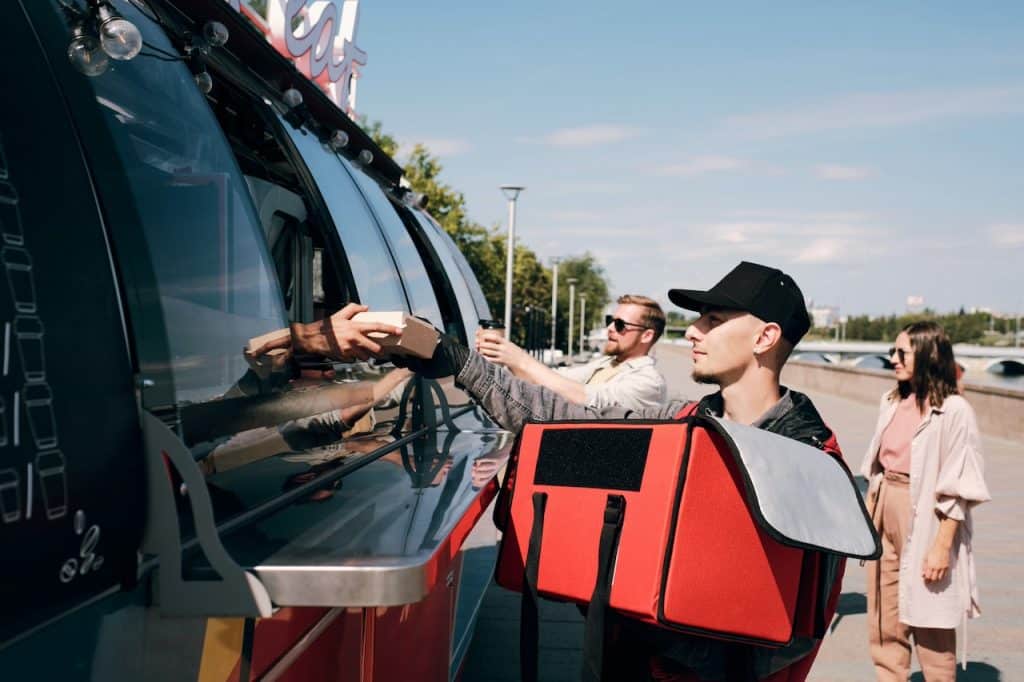
A mobile ghost kitchen is a delivery-focused restaurant operated from a movable commercial kitchen. It combines the low-footprint operating model of a ghost kitchen with the mobility of a food truck, trailer, van or other approved mobile food unit.
Instead of paying for a traditional restaurant with a dining room, the owner concentrates on food preparation, online ordering, takeaway and delivery. Customers may never see the kitchen. They order through a website, mobile ordering system, social media, a delivery marketplace or another digital channel, and the food is delivered or collected.
The model is attracting interest from food entrepreneurs because it can provide more flexibility than a conventional restaurant. However, a mobile ghost kitchen is still a food business. Moving the kitchen onto wheels does not remove food-safety, licensing, zoning, tax, fire, vehicle, insurance or location requirements.
The exact rules depend on where the business operates. A mobile ghost kitchen in Florida can face different requirements from one in Toronto, London, Dubai, Sydney, São Paulo or Manila.
The following guide explains how to start one, what it can cost, what equipment you may need, how permits work, and what aspiring operators should consider in the USA, Canada, UK, Australia, UAE, South America and Southeast Asia.
What Is a Mobile Ghost Kitchen?
A mobile ghost kitchen is a commercial food-preparation operation that can change location and primarily serves customers through delivery and takeaway rather than a conventional dining room.
The kitchen might operate from:
- A food truck
- A food trailer
- A converted van
- A mobile catering vehicle
- A portable commercial kitchen
- An approved container-based kitchen
- Another movable food premises
The business can be delivery-only, pickup-oriented, or a combination of delivery and event sales.
For example, an entrepreneur could operate a burger brand from a trailer parked at an approved commercial property. Orders come through an online ordering system, the kitchen prepares the food, and customers either collect their meals or have them delivered.
The important distinction is that the business does not need a conventional customer-facing restaurant.
The concept is therefore particularly interesting for entrepreneurs who want to test a restaurant brand without committing to a full-size dining room.
Mobile Ghost Kitchen vs. Traditional Ghost Kitchen vs. Food Truck
These concepts overlap, but they are not identical.
| Model | Kitchen moves? | Dining room? | Primary sales channel |
|---|---|---|---|
| Traditional restaurant | No | Usually | Dine-in, takeaway, delivery |
| Ghost kitchen | Usually no | No | Delivery and takeaway |
| Food truck | Yes | No | Walk-up, events, takeaway |
| Mobile ghost kitchen | Yes | No | Delivery, pickup, events |
A traditional food truck often depends heavily on foot traffic. A mobile ghost kitchen can be designed around online demand instead.
That changes how you choose locations.
Instead of asking, “Where are there the most pedestrians?” you may ask, “Where can I legally park the kitchen while remaining close enough to my customers to deliver quickly?”
That is a different business model.
Why Start a Mobile Ghost Kitchen?
There are several reasons entrepreneurs consider the model.
Lower physical footprint
You do not necessarily need a dining room, customer bathrooms, large dining area or conventional storefront.
Mobility
The business can potentially operate in different neighborhoods, commercial districts, events and private properties, subject to local rules.
Delivery-first operation
A carefully designed menu can be built specifically for online ordering and delivery.
Easier concept testing
An entrepreneur can test a cuisine or restaurant concept without immediately signing a long commercial lease.
Multiple revenue channels
The same kitchen can potentially serve:
- Delivery customers
- Pickup customers
- Corporate catering
- Private events
- Festivals
- Markets
- Pop-ups
- Food-truck customers
The tradeoff is that the business has less physical space and can face more complicated location and mobile-food regulations.
How Much Does a Mobile Ghost Kitchen Cost?
Startup costs vary dramatically according to the vehicle, menu, equipment and country.
A reasonable U.S. planning budget for a small-to-medium operation might look like this:
| Startup expense | Typical planning range |
|---|---|
| Used truck or trailer | $20,000–$80,000+ |
| New/custom mobile kitchen | $70,000–$200,000+ |
| Kitchen equipment | $10,000–$60,000+ |
| Refrigeration/freezing | $3,000–$15,000+ |
| Generator/electrical system | $3,000–$15,000+ |
| Plumbing/water system | $2,000–$10,000+ |
| POS and ordering technology | $500–$5,000+ |
| Permits and inspections | $500–$5,000+ |
| Insurance | $1,000–$5,000+ annually |
| Branding/website | $1,000–$10,000 |
| Initial inventory | $2,000–$8,000 |
| Commissary/parking deposits | $1,000–$10,000+ |
| Working capital | $10,000–$30,000+ |
These figures are not universal license fees or government estimates. They are planning ranges intended to demonstrate the scale of investment.
The biggest mistake is to think that purchasing a cheap truck means starting a cheap restaurant.
A $25,000 vehicle may require substantial additional spending on:
- Plumbing
- Electrical work
- Refrigeration
- Cooking equipment
- Ventilation
- Fire suppression
- Handwashing
- Food-preparation surfaces
- Water storage
- Wastewater storage
- Generator capacity
- Inspections
- Repairs
In other words, the vehicle is only the shell.
Step 1: Choose Your Food Concept
Start with the food, not the truck.
A mobile kitchen has limited space, so a complicated restaurant menu can become difficult to operate.
Good mobile concepts often have ingredients that can be used across several dishes.
For example, a Mexican concept might use the same:
- Chicken
- Beef
- Beans
- Rice
- Salsa
- Tortillas
- Cheese
- Vegetables
across tacos, burritos, bowls and quesadillas.
A smaller menu also makes purchasing and inventory control easier.
Before buying equipment, determine:
- Menu items
- Ingredients
- Preparation methods
- Cooking times
- Refrigeration requirements
- Freezer requirements
- Required equipment
- Packaging
- Expected order volume
Your menu should dictate the kitchen layout.
Not the other way around.
Step 2: Research the Local Market
A mobile ghost kitchen still needs customers.
Research the delivery market in the geographic area where you intend to operate.
Look at:
- Competing restaurants
- Menu prices
- Average order values
- Delivery fees
- Customer reviews
- Delivery times
- Popular cuisines
- Busy ordering periods
- Residential density
- Office districts
- Universities
- Hotels
- Events
- Competitor promotions
Read negative reviews carefully.
They often reveal opportunities.
Customers may complain about long delivery times, poor packaging, small portions, inconsistent quality or limited late-night choices. Those complaints can help shape your concept.
Step 3: Decide Where the Kitchen Will Operate
This is one of the most important decisions in the business.
A mobile kitchen does not necessarily have the right to park and sell food wherever the owner wants.
Potential operating locations include:
- Private commercial properties
- Office parks
- Apartment communities
- Shopping centers
- Business districts
- Events
- Markets
- Festivals
- Industrial areas
- University areas
- Approved public vending locations
Private-property agreements can be useful because they can provide a predictable operating location, but zoning, vending and health regulations still need to be checked.
If your business intends to move between several cities or municipalities, investigate the requirements for each area before advertising those locations.
Step 4: Check Regulations Before Buying the Truck
This is perhaps the most important practical recommendation in the entire process.
Do not purchase a mobile kitchen first and ask the health department about it later.
Contact the appropriate authority and ask what is required for your specific menu and equipment.
Provide information about:
- Menu
- Vehicle type
- Food preparation
- Cooking equipment
- Refrigeration
- Water system
- Wastewater system
- Food storage
- Commissary arrangements
- Operating locations
- Food transportation
Regulators may have different requirements depending on whether food is prepared entirely on the vehicle or whether some preparation occurs at an approved commissary.
The FDA’s 2026 Food Code is particularly relevant here. The new edition explicitly adds a definition for “mobile food establishment” and includes updated guidance concerning mobile food establishments. The Food Code remains a model for state, local, tribal and territorial regulators rather than a single federal restaurant license.
Step 5: Find a Commissary Kitchen
A commissary is an approved commercial kitchen or support facility used by mobile food operators.
Depending on the jurisdiction, your commissary may provide:
- Potable water
- Food storage
- Refrigeration
- Freezer storage
- Food preparation
- Equipment cleaning
- Dishwashing
- Wastewater disposal
- Grease disposal
- Garbage disposal
- Overnight vehicle parking
Not every mobile ghost kitchen will need exactly the same commissary arrangement. Requirements depend on the local authority and the capabilities of the mobile unit.
The FDA’s mobile-food guidance recognizes that auxiliary support such as a commissary or servicing area can depend on the menu, operation and equipment available on the mobile unit.
Step 6: Design the Kitchen Around the Menu
A mobile ghost kitchen needs an efficient workflow because space is limited.
A typical workflow might be:
Storage → Preparation → Cooking → Assembly → Packaging → Pickup/Delivery
Avoid forcing employees to cross paths unnecessarily.
Important equipment can include:
- Reach-in refrigerator
- Undercounter refrigerator
- Freezer
- Prep table
- Commercial range
- Griddle
- Fryer
- Oven
- Pizza oven
- Food warmer
- Handwashing sink
- Three-compartment sink where required
- Shelving
- Food containers
- POS terminal
- Receipt printer
- Kitchen display system
- Generator
- Water heater
- Fresh-water tank
- Wastewater tank
The menu determines which items are actually necessary.
A smoothie concept, for example, does not need the same equipment as a fried-chicken operation.
Step 7: Build a Food-Safety System
Food safety should be designed into the operation rather than treated as an inspection-day exercise.
Develop procedures for:
- Receiving
- Refrigeration
- Freezing
- Cooking
- Cooling
- Reheating
- Holding
- Handwashing
- Cleaning
- Sanitizing
- Allergen control
- Cross-contamination prevention
- Pest control
- Waste disposal
- Employee illness
- Delivery
The 2026 FDA Food Code includes updates concerning employee illness policies, allergen cross-contact and mobile food establishments.
Temperature control becomes particularly important when food is transported from a mobile kitchen to customers.
Step 8: Register the Business
The business-registration process varies by country.
Depending on the jurisdiction, you may need:
- Business entity registration
- Business name registration
- Tax registration
- Sales-tax/GST/VAT registration
- Employer registration
- Food-business registration
- Local business licence
- Mobile vending permit
Do not confuse business registration with food-service approval.
A company can be legally registered while still being prohibited from preparing or selling food until it receives the necessary health and operating approvals.
Step 9: Get the Required Permits
A mobile ghost kitchen can potentially require several different approvals.
Food-business approval
Confirms that the food operation meets applicable food-safety requirements.
Mobile-vending permit
May authorize the vehicle to operate as a mobile food business.
Health inspection
The unit may need inspection before opening.
Fire approval
Gas, propane, cooking equipment, generators, fryers, exhaust systems and fire suppression may require approval.
Vehicle registration
The vehicle must meet road and registration requirements.
Location permission
A food permit does not necessarily give you permission to sell at every location.
Wastewater approval
You need a legal way to dispose of wastewater and cooking waste.
Insurance
Commercial vehicle, general liability, product liability and employee-related coverage may be relevant.
Mobile Ghost Kitchen Regulations Around the World
There is no single international mobile ghost-kitchen permit. The regulatory framework changes from country to country and frequently from city to city.
United States
In the U.S., restaurant and food-truck operations are generally regulated by state and local authorities rather than by the FDA directly. The FDA Food Code is a model used by jurisdictions to develop retail-food regulations.
The FDA’s newly released 2026 Food Code is the current edition and specifically adds a definition of a mobile food establishment.
A U.S. mobile ghost kitchen may need:
- Business registration
- State tax registration
- Local business licence
- Mobile food permit
- Health department approval
- Plan review
- Food manager certification
- Commissary agreement
- Fire inspection
- Vehicle registration
- Commercial insurance
- Wastewater arrangements
- Approved operating locations
The exact list depends on the state and municipality.
Canada
Canadian operators need to consider federal, provincial and municipal requirements.
The Canadian Food Inspection Agency states that licensing under the Safe Food for Canadians Regulations depends on the food activities being performed rather than simply the type of business.
A local mobile ghost kitchen may also need provincial health approval, municipal licensing, food-handler certification, vehicle requirements and permission to operate at particular locations.
Entrepreneurs should check the relevant provincial health authority and municipality before investing in a vehicle.
United Kingdom
The UK has an established registration system for food businesses.
GOV.UK states that businesses selling, cooking, storing, handling, preparing or distributing food may need to register with their local authority. This specifically includes mobile units, temporary premises and businesses selling food online.
In England, Wales and Northern Ireland, food businesses generally need to register at least 28 days before trading.
A mobile ghost kitchen should investigate:
- Food-business registration
- Street-trading requirements
- Food hygiene
- Allergen information
- Vehicle requirements
- Waste disposal
- Insurance
- Tax registration
- Trading-location permissions
If the business operates at more than one location, the local-authority requirements for those locations need to be considered.
Australia
Australia is particularly clear about mobile food businesses.
Food Standards Australia New Zealand describes mobile food businesses as including food vans, trucks, trailers and other movable food premises. These businesses must meet relevant food-safety requirements under the Food Standards Code.
Operators generally need to notify the appropriate food regulatory agency before beginning food-handling operations. For mobile businesses, this can involve the council where the vehicle is garaged as well as other councils where the business operates.
Depending on the operation, Australian mobile food businesses can also be subject to Standard 3.2.2A, which includes food-safety management tools for certain businesses handling unpackaged, potentially hazardous ready-to-eat food. Food vans and similar operations can fall within this framework.
UAE
The UAE requires a more emirate-specific approach.
A mobile ghost kitchen in Dubai should be researched through Dubai Municipality and the relevant business-licensing authorities.
Dubai Municipality publishes food-establishment requirements, food-related permits and approvals, and requirements concerning food transportation and delivery vehicles.
Potential requirements can include:
- Commercial licence
- Food-establishment approval
- Kitchen approval
- Vehicle approval
- Food transportation requirements
- Food-safety training
- Fire and safety approvals
- Waste arrangements
- Permission for specific operating locations
Do not assume that a Dubai food-truck approval automatically provides unrestricted permission to trade throughout the emirate.
South America
South America contains numerous regulatory systems, so the correct approach is to investigate the specific country and municipality.
Brazil provides a useful example. Brazil’s government explains that business licensing involves regulatory assessments covering areas such as sanitary safety, environmental controls and fire prevention before a business can be definitively legalized.
Brazil’s health regulator, ANVISA, also explains that local operating authorization for food businesses is handled through the relevant municipal or state sanitary authority.
In other South American countries, entrepreneurs should investigate:
- Company registration
- Tax registration
- Municipal operating licence
- Sanitary authorization
- Food-handler requirements
- Mobile-vending rules
- Fire certification
- Vehicle requirements
- Wastewater disposal
- Trading locations
Do not assume that rules in Brazil automatically apply to Argentina, Chile, Colombia, Peru, Ecuador or another country.
Southeast Asia
Southeast Asia also requires a country-by-country approach.
Singapore, Malaysia, Indonesia, Thailand, the Philippines and Vietnam all have different licensing, food-safety and local-government systems.
A mobile ghost kitchen should generally investigate:
- Company registration
- Food-business licensing
- Sanitary permits
- Local operating permits
- Food-handler requirements
- Fire clearance
- Vehicle registration
- Mobile-vending permissions
- Waste disposal
- Tax obligations
- Delivery requirements
Foreign entrepreneurs should also check ownership restrictions and local company-formation requirements before investing.
Mobile Ghost Kitchen Equipment Checklist
Before opening, consider whether the vehicle has the following:
Food preparation
- Stainless-steel prep surfaces
- Cutting boards
- Knives
- Food processors
- Mixers
- Ingredient containers
- Shelving
Cooking
- Range
- Griddle
- Fryer
- Oven
- Grill
- Steam equipment
- Microwave
- Induction equipment
Refrigeration
- Refrigerator
- Freezer
- Undercounter refrigeration
- Refrigerated prep table
Cleaning
- Handwashing sink
- Dishwashing system
- Hot water
- Sanitizer
- Cleaning chemicals
- Waste containers
Utilities
- Generator
- Electrical distribution
- Fresh-water tank
- Wastewater tank
- Water heater
- Propane system where applicable
- Ventilation
Technology
- POS
- Kitchen display system
- Online ordering
- Payment terminal
- Receipt printer
- Wi-Fi/cellular connection
- Inventory management
The final equipment list should be determined by the menu, vehicle design and regulatory requirements.
How to Make a Mobile Ghost Kitchen Profitable
Revenue is not the same as profit.
Suppose the average order is $25.
You need to understand what happens to that $25 after:
- Food
- Packaging
- Payment processing
- Delivery commissions
- Discounts
- Refunds
- Labor
- Fuel
- Waste
- Rent or commissary costs
- Insurance
- Repairs
- Taxes
A useful operating metric is contribution margin per order.
For example:
Average order: $25
Food: $7
Packaging: $1.50
Payment/delivery variable costs: $4.50
Contribution before fixed overhead: $12
At 40 orders per day for 26 operating days:
40 × $26 × $12 = $12,480
That is not net profit. It is an illustration of how order economics can be modeled before fixed expenses such as payroll, insurance, commissary rent, vehicle financing, fuel, marketing and administration.
The actual numbers will differ from business to business.
Keep the Menu Small at First
One of the easiest ways to lose control of a mobile kitchen is to offer too many products.
Start with a menu that is operationally manageable.
A focused menu can reduce:
- Food waste
- Inventory requirements
- Prep time
- Storage requirements
- Employee training
- Ticket times
- Purchasing complexity
Once sales data shows which products customers actually buy, expand deliberately.
Build the Ordering System Before Launch
A mobile ghost kitchen needs a strong digital storefront.
At minimum, consider:
- Online menu
- Direct ordering
- POS
- Payment processing
- Kitchen order management
- Customer notifications
- Delivery integration
- Inventory tracking
- Sales reporting
Third-party delivery marketplaces can help a new brand reach customers, but commission costs should be included in the financial model.
The long-term objective should be to build a recognizable brand rather than simply become another anonymous listing on a delivery app.
Design Packaging Around the Food
Packaging can make or break a delivery restaurant.
Test your food after:
- Five minutes
- Ten minutes
- Twenty minutes
- Thirty minutes
Look for:
- Sogginess
- Heat loss
- Leaking sauces
- Crushed products
- Condensation
- Portion problems
- Separation of hot and cold foods
A product that tastes excellent when it leaves the kitchen but arrives in poor condition is not a successful delivery product.
Hire for Speed and Consistency
Mobile kitchens have little room for inefficient labor.
Write simple procedures for:
- Opening
- Prep
- Receiving
- Temperature checks
- Cooking
- Assembly
- Packaging
- Order verification
- Cleaning
- Closing
- Waste
- Cash handling
Every employee should know what happens when five orders arrive simultaneously.
That is where a small kitchen either works smoothly or becomes overwhelmed.
Marketing a Mobile Ghost Kitchen
Because there may be no traditional storefront, digital marketing is especially important.
Build visibility through:
- Local SEO
- Google Business Profile where appropriate
- Social media
- Online ordering
- SMS
- Delivery platforms
- Local partnerships
- Corporate catering
- Events
- Loyalty programs
Location-based marketing can be particularly effective.
Instead of advertising to an entire city, concentrate on the delivery zones that produce the best order economics.
Mobile Ghost Kitchen Opening Checklist
Before launch, verify the following:
Business
- Business entity registered
- Tax registration completed
- Business bank account established
- Accounting system established
- Insurance purchased
Kitchen
- Vehicle purchased
- Kitchen designed
- Equipment installed
- Plumbing completed
- Electrical system completed
- Refrigeration installed
- Ventilation completed
- Fire requirements satisfied
- Water system approved
- Wastewater system approved
Food safety
- Food-business registration completed
- Health approval obtained
- Food-safety plan established
- Food-handler training completed
- Temperature procedures established
- Cleaning procedures established
- Allergen procedures established
Operations
- Commissary arranged
- Suppliers established
- Menu tested
- Recipes standardized
- Packaging tested
- POS installed
- Online ordering activated
- Delivery workflow tested
Location
- Parking arranged
- Vending permissions confirmed
- Event permits obtained where necessary
- Zoning checked
- Operating locations approved
Financial
- Startup budget completed
- Working capital reserved
- Menu costs calculated
- Food-cost targets established
- Labor budget established
- Break-even point calculated
How Long Does It Take to Open?
The timeline depends heavily on the vehicle and jurisdiction.
A business purchasing an already compliant vehicle may be able to move considerably faster than one building a custom kitchen from an empty trailer.
A practical planning sequence is:
Weeks 1–2: Concept, market research and business plan
Weeks 2–5: Regulatory research, location research and financing
Weeks 4–10: Vehicle selection and kitchen design
Weeks 6–14: Construction, equipment installation and branding
Weeks 8–16: Permits, inspections and food-safety preparation
Weeks 10–16: Menu testing, supplier setup and technology
Weeks 14–18: Soft launch and operational testing
This is only a planning framework. Construction delays, inspections, permit processing and vehicle availability can make the process substantially longer.
Final Advice for Aspiring Mobile Ghost Kitchen Owners
The mobile ghost kitchen model is attractive because it removes some of the costs and operational requirements associated with a conventional restaurant. But it should not be treated as a shortcut around restaurant regulation.
The strongest approach is to work backward from the operation you want to run.
First decide what you will sell.
Then determine how the food needs to be prepared.
Then design the kitchen.
Then determine what permits and approvals are required.
Then choose the vehicle.
Then build the ordering, delivery and financial systems.
That sequence matters.
The wrong vehicle can force expensive modifications. The wrong menu can overwhelm a small kitchen. The wrong location can make delivery economics impossible. And a kitchen that does not satisfy local food-safety requirements can prevent the business from opening at all.
The regulatory landscape is also changing. In the United States, the FDA’s 2026 Food Code now explicitly addresses mobile food establishments, while Australia has specific national food-safety standards covering mobile businesses. The UK requires food businesses, including mobile units and online food businesses, to register with the appropriate local authority.
For an entrepreneur, the lesson is straightforward: research the rules before spending the money.
A mobile ghost kitchen can be built around a relatively small menu, a compact kitchen, online ordering and a defined delivery area. If the concept is designed around the realities of mobile food production from the beginning, the business can remain lean while still operating like a professional restaurant.
The objective is not simply to put a kitchen on wheels.
It is to build a restaurant that happens to move.


