
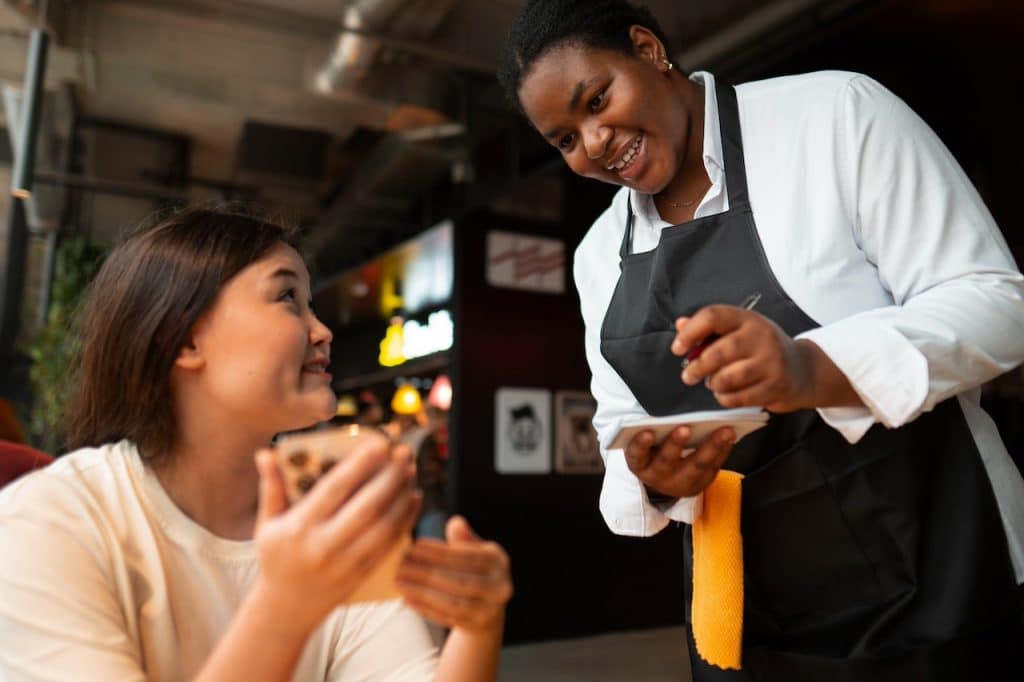
South Africa as a popular tourist destination, has a well-established restaurant tipping culture, and tipping is an important part of the relationship between diners and hospitality workers. Whether someone is eating at a neighbourhood restaurant in Johannesburg, enjoying seafood along the Cape Town waterfront, having breakfast at a guesthouse in the Garden Route, or dining at a luxury safari lodge in Mpumalanga, they will encounter tipping as a familiar part of the dining experience.
For visitors from countries where tipping is optional, unfamiliar, or included in the bill, understanding South African tipping customs can prevent awkward situations. For restaurant owners, managers, and hospitality professionals, understanding tipping is equally important. It influences staff earnings, service expectations, customer satisfaction, and the way restaurants manage their operations.
In South Africa, a tip of around 10% of the bill is the traditional starting point for restaurant service, while 12.5% to 15% is common when customers are particularly happy with the experience. Some diners leave more for exceptional service, while others leave less when service has been disappointing. The precise amount depends on the establishment, the quality of service, the size of the bill, and whether a service charge has already been added.
Unlike a compulsory tax, a conventional restaurant tip is generally voluntary. However, it is sufficiently established in South African hospitality that leaving nothing without a reason may be viewed as a sign of dissatisfaction or a departure from local dining etiquette.
This guide examines how restaurant tipping works in South Africa, how much customers are expected to leave, who receives the money, how service charges are handled, and what restaurant operators should understand about tipping practices.
How Much Should You Tip at a Restaurant in South Africa?
The most widely recognised restaurant tipping guideline in South Africa is 10% of the final bill. This is the amount many local diners use when they receive satisfactory service. Customers who receive particularly good service may leave 12.5%, 15%, or even 20%, depending on their budget and the experience.
South African tourism guidance commonly places restaurant tips in the 10% to 20% range. For international visitors, 10% is a reasonable starting point, while 15% is a generous gratuity for good service.
Here is how different tipping percentages work in practice:
| Restaurant bill | 10% tip | 12.5% tip | 15% tip | 20% tip |
|---|---|---|---|---|
| R200 | R20 | R25 | R30 | R40 |
| R350 | R35 | R43.75 | R52.50 | R70 |
| R500 | R50 | R62.50 | R75 | R100 |
| R750 | R75 | R93.75 | R112.50 | R150 |
| R1,000 | R100 | R125 | R150 | R200 |
| R1,500 | R150 | R187.50 | R225 | R300 |
These amounts are examples rather than compulsory charges. A customer spending R500 at a restaurant might leave R50 for ordinary, satisfactory service or R75 for a particularly good experience.
There is no requirement to follow a percentage mechanically. Someone who receives poor service can leave less, while a customer who has experienced outstanding hospitality may decide to give more.
For restaurant operators, understanding these expectations helps when training waiting staff. Employees should know that a tip is earned through service and should never be treated as an automatic entitlement to demand additional money from customers.
Is Tipping Compulsory in South African Restaurants?
No. Tipping is customary in South Africa, but a voluntary gratuity is not a compulsory payment under South African law.
This distinction is important because customers sometimes confuse a customary 10% tip with an obligatory restaurant charge. The two are different.
A customer can decide whether to tip and how much to leave. A restaurant cannot simply insist that every customer must pay a discretionary gratuity because it is customary to do so.
However, restaurants can have clearly disclosed service-charge arrangements, particularly for large tables or group bookings. These arrangements need to be communicated properly so that customers understand what they are agreeing to before settling the bill.
The Consumer Protection Act 68 of 2008 is relevant to how businesses communicate prices and additional charges. Customers should be able to understand the charges applied to their purchases before they agree to pay.
A restaurant should ideally display its large-group service-charge policy on its menu, website, booking confirmation, or another document customers can easily access.
Waiters should also be trained to explain the charge politely when customers ask about it.
The practical lesson is straightforward: customers should check their bills, and restaurants should make their service-charge policies clear before customers order.
Why Do South African Waiters Depend on Tips?
Restaurant tipping has a particular economic significance in South Africa because gratuities can make up a meaningful portion of a waiter’s take-home earnings.
Waiting tables involves much more than carrying food from the kitchen to a customer’s table. A waiter may be responsible for welcoming guests, explaining menu items, taking orders, communicating dietary requirements, monitoring food preparation, serving drinks, checking on meals, processing payments, and clearing tables.
During busy periods, one employee might look after several tables at once. They must remember individual orders, manage requests, deal with complaints, and coordinate with kitchen staff.
The work can be physically demanding. Long shifts, weekend work, public holidays, and evening service are common in restaurants.
Tips provide customers with an opportunity to reward employees for the quality of the service they receive. For some waiters, these gratuities make a substantial difference to their monthly income.
However, it is important to understand that tips should not replace an employer’s legal obligations. South African employment law establishes minimum employment standards, and employers cannot simply use anticipated tips to avoid paying employees the applicable minimum wage.
The distinction between wages and gratuities matters. A restaurant must manage its payroll responsibilities separately from customer tips.
For restaurant owners, relying on gratuities as a substitute for proper remuneration creates employment and operational risks. It can also contribute to staff dissatisfaction and high employee turnover.
How Are Restaurant Tips Distributed in South Africa?
A common assumption among diners is that every tip goes directly to the waiter who served them. In practice, the arrangements vary from one restaurant to another.
Some establishments allow waiters to keep their individual tips. Others operate a shared tipping system, sometimes called a tip pool.
Under a tip-pooling arrangement, gratuities are collected and distributed among employees according to an agreed formula.
For example, a restaurant might allocate a portion of the pooled tips to waiting staff, with another portion shared among bartenders, kitchen employees, food runners, and other members of the service team.
The reasoning is that restaurant service involves several people. A customer may interact with one waiter, but the kitchen team prepares the meal, the bartender prepares drinks, and other employees help ensure that orders reach the correct tables.
There is no single distribution formula used by every South African restaurant.
Some restaurants use a points-based system, where employees receive a share according to their role and working hours. Others divide the collected amount among participating employees at the end of a shift.
For customers who want to understand where their money goes, it is reasonable to ask the restaurant how its tipping arrangements work.
For restaurant management, the policy should be documented and communicated to employees. Staff should understand:
- Whether individual tips are kept by the person receiving them.
- Whether the restaurant operates a shared tipping pool.
- Which employees participate in the pool.
- How the distribution percentage is calculated.
- How cash and card gratuities are recorded.
- When employees receive their allocated tips.
Clear arrangements reduce disagreements and help employees understand how their earnings are calculated.
Cash Tips vs Card Tips: Which Is Better?
South African restaurants accept card payments widely, and customers increasingly use debit cards, credit cards, and digital payment methods to settle their bills.
This has created two common ways to leave a gratuity: handing cash directly to the waiter or adding a tip when paying by card.
Both methods can work, but customers should understand how the restaurant processes card gratuities.
Cash tips
Cash is a straightforward option. A customer can calculate the desired amount and hand it directly to the waiter.
For example, if the bill is R460 and the customer wants to leave a 10% tip, they can give the waiter R506 in cash, provided the restaurant accepts cash settlement, or pay the R460 bill and hand over R46 separately.
The advantage is that the customer can give the gratuity directly to the employee.
However, where a restaurant operates a shared tipping policy, the waiter may still need to contribute the cash to the agreed pool.
Card tips
Many restaurants allow customers to add a gratuity when paying through a card machine.
A waiter might ask, “Would you like to add a tip?” before entering the final amount.
The customer can then choose the amount they wish to leave, subject to the payment terminal’s functionality.
For instance, a customer with a R650 bill might request a total card payment of R715, leaving R65 as a 10% gratuity.
Card tips are convenient because customers do not need to carry additional cash.
However, the restaurant must have a proper process for recording and distributing these amounts. Customers should not assume that a card gratuity automatically goes into the individual waiter’s pocket.
Which option should customers choose?
Either method is acceptable. If a customer is uncertain about how card tips are distributed, they can ask the waiter or manager. A restaurant that handles gratuities properly should be able to explain its policy.
Restaurant operators should also make sure their point-of-sale systems can distinguish food and beverage sales from gratuities. This helps with reconciliation, reporting, and staff tip allocation.
Do South African Restaurants Automatically Add a Service Charge?
Some South African restaurants automatically add a service charge, particularly when a large group occupies a table.
A charge of 10% is a familiar arrangement, although the percentage and minimum group size vary between establishments.
For example, a restaurant might apply a 10% service charge to bookings of eight or more guests. Another restaurant might only introduce the charge for groups of ten or twelve.
The reason is largely operational.
Large groups can require considerably more attention than smaller tables. A waiter may spend extra time taking individual orders, coordinating meals, processing separate payments, and responding to requests from several customers.
During that period, the waiter may be unable to serve other tables.
A group service charge is one way some restaurants recognise the additional work involved.
Nevertheless, customers should be informed before the charge is applied. A restaurant should not rely on customers discovering an unfamiliar fee after the meal.
Customers should also check whether the service charge has already been included before adding another gratuity.
For example, consider a group of ten people with a final bill of R3,000. If the restaurant has already added a disclosed 10% service charge, the customer should recognise that R300 has already been included for service.
There is no automatic expectation that another 10% must be added.
If the group wants to reward particularly good service with an additional amount, that remains a personal decision.
What Should Tourists Know About Tipping in South African Restaurants?
International visitors sometimes arrive in South Africa with tipping habits learned in their home countries.
In the United States, for example, restaurant customers may be accustomed to leaving 18% to 20% or more. In some European countries, a service charge may already be included in the bill, while other destinations have a less established tipping culture.
South Africa has its own expectations.
For tourists, a 10% gratuity is a reasonable starting point for satisfactory restaurant service. Leaving 12.5% to 15% for particularly good service is also common.
The amount is generally calculated using the restaurant bill in South African rand (ZAR).
Visitors should remember that VAT is already included in the advertised prices of most restaurant menu items. VAT is a government tax, not a gratuity for the waiter.
A restaurant bill may show VAT information separately, depending on how the business presents its invoice. This should not be confused with a service charge.
Tourists dining in popular areas such as the V&A Waterfront in Cape Town, Sandton in Johannesburg, Umhlanga in Durban, or the Winelands should follow the same basic tipping principles.
A more expensive restaurant does not automatically require a higher percentage. The gratuity should reflect the service received and the customer’s own judgment.
Visitors should also avoid assuming that every employee in a restaurant receives an equal share of tips. Distribution depends on the establishment’s arrangements.
Is Restaurant Tipping Different at Fine-Dining Restaurants?
Fine-dining restaurants generally involve a more detailed service experience than casual dining establishments.
Customers may receive assistance with wine selection, explanations of individual courses, food-pairing recommendations, special dietary requests, and carefully timed service.
The waiter may also coordinate with sommeliers, chefs, restaurant managers, and other service employees throughout the meal.
In these establishments, customers often leave 10% to 15% for satisfactory service, with 15% to 20% being a generous reward for an exceptional experience.
However, fine dining does not automatically mean customers must leave 20%.
Restaurant pricing, service standards, and tipping arrangements differ. Some premium establishments have more structured service charges or shared gratuity arrangements.
Customers should check their bills before making a decision.
For managers of fine-dining establishments, communication is particularly important. Employees should be trained to explain wine recommendations, course descriptions, and billing arrangements without making customers feel pressured to spend more.
A well-managed service experience should leave the customer comfortable with the final payment.
Should Customers Tip at Fast-Food Restaurants and Takeaways?
Tipping is much less established at fast-food outlets and takeaway counters than at traditional sit-down restaurants.
At a fast-food establishment, customers generally place an order at a counter or through a self-service system. They collect their food and leave, with little or no table service involved.
There is no general expectation that customers must leave a percentage of their order as a tip.
Some businesses have tip jars near the till or payment terminals with an optional gratuity function. Customers can contribute if they wish, but they should not feel obliged to do so.
The same principle applies to takeaway orders from independent cafés, burger shops, pizzerias, and small food businesses.
If an employee provides additional assistance, such as helping carry a large order or accommodating a special request, a customer may choose to leave a small gratuity.
For restaurant owners, optional tip prompts should be presented honestly. A payment terminal should clearly distinguish an optional gratuity from the actual price of the food.
How Should Customers Handle Poor Restaurant Service?
Tipping customs should not prevent customers from expressing dissatisfaction when the service is genuinely poor.
There are several reasons why a customer might decide to reduce or withhold a tip:
- The waiter repeatedly ignores requests for assistance.
- Orders are entered incorrectly and the employee makes little effort to resolve the problem.
- The customer is treated rudely or disrespectfully.
- The waiter provides misleading information about menu items.
- The service is unnecessarily delayed without an explanation.
- A billing dispute is handled unprofessionally.
Customers should distinguish between problems caused by the waiter and problems outside their control.
For example, a kitchen delay might be caused by a shortage of staff or an unexpected rush of orders. The waiter may have communicated the problem properly and made reasonable efforts to help.
It would be unfair to automatically blame the server for every operational problem.
On the other hand, repeatedly ignoring customers or displaying an unacceptable attitude is a legitimate reason to reconsider the gratuity.
If the experience is particularly poor, customers should speak to a manager and explain what happened. This gives the restaurant an opportunity to investigate and correct the problem.
Managers should take complaints seriously. A missing tip can sometimes indicate dissatisfaction, but it should not be treated as proof that a customer has behaved badly.
Staff should never intimidate, insult, or harass customers for choosing not to tip.
What Restaurant Owners Should Know About Managing Tips
For restaurant owners and managers, tipping requires more attention than simply asking customers to leave an additional amount.
A poorly managed tipping arrangement can cause disputes between employees, damage customer relationships, and create problems with financial reporting.
The first step is to establish a written tipping policy.
The policy should explain whether tips belong to individual employees or are shared among a team. If a tip pool is used, the distribution formula should be transparent and agreed upon by the participating employees.
Managers should also separate gratuities from normal restaurant revenue in their accounting records.
For example, a restaurant that records a R1,000 food sale and a R150 card gratuity should be able to identify the R1,000 as the sale and the R150 as a gratuity payable or distributable under its tipping arrangement.
Treating the entire R1,150 as ordinary food revenue can create confusion when reconciling payments and calculating staff earnings.
Using restaurant POS software to manage tips
A restaurant point-of-sale system can make tip management easier by recording gratuities separately from food and beverage transactions.
Depending on the software and payment integration, a POS system can help restaurant operators:
- Record the original transaction value and the additional gratuity.
- Identify cash and card payments.
- Track tips associated with individual employees or shifts.
- Generate sales and payment reconciliation reports.
- Compare tip totals across different service periods.
- Support internal tip-pooling calculations.
- Reduce manual calculations when preparing staff tip reports.
For independent restaurants, cafés, and coffee shops, this is particularly useful during busy trading periods when employees process many transactions.
A system such as Slant POS can help restaurant operators manage everyday sales and payment records as part of their wider restaurant operations. However, owners should confirm that their particular payment setup supports the gratuity functions and reporting arrangements they intend to use.
POS software does not replace the need for a clear employee tipping policy. The restaurant must still decide how tips are handled and ensure that the process is understood by staff.
How Can Restaurants Encourage Better Tipping Without Pressuring Customers?
Good service is the most reliable way for a restaurant to encourage customers to leave a gratuity.
Customers are more likely to reward employees when they feel welcomed, receive accurate orders, and enjoy attentive service throughout their visit.
Restaurant managers can improve service standards by concentrating on practical staff training.
New employees should learn how to greet customers, explain menu items, handle complaints, communicate with kitchen staff, and process payments.
They should also understand when to check on customers without interrupting conversations unnecessarily.
A waiter who pays attention to the table can often identify problems before they become complaints.
Restaurants should also ensure that employees understand the menu, including portion sizes, ingredients, allergens, and available alternatives. Customers appreciate accurate information, particularly when they have dietary restrictions.
Another important consideration is staff scheduling. Understaffing can lead to slow service, frustrated customers, and reduced gratuities.
Managers should monitor customer traffic and schedule enough employees to handle busy periods.
Finally, tipping should never become an aggressive sales target. Employees should not be instructed to pressure customers, suggest that a particular percentage is mandatory, or argue about the amount left.
A polite approach is sufficient. The customer should be free to make the final decision.
Frequently Asked Questions About Restaurant Tipping in South Africa
1. What is the standard restaurant tip in South Africa?
A 10% tip is the traditional standard for restaurant service in South Africa. Many customers leave 12.5% to 15% for particularly good service, while 20% is considered generous.
2. Is it rude not to tip a waiter in South Africa?
Tipping is an established custom, so leaving nothing after satisfactory service may be considered discourteous. However, tips are voluntary, and customers can withhold them when service has been unsatisfactory.
3. Do South African restaurants include tips in their menu prices?
Ordinary menu prices generally do not include a voluntary waiter gratuity. Some restaurants add a separate service charge, particularly for larger groups. Customers should check the bill.
4. Do I tip on the total bill or before VAT?
Most diners calculate their gratuity using the final amount payable. If the bill is R800, a 10% tip would be R80. Customers do not generally need to calculate a separate pre-VAT amount.
5. Do restaurants charge 10% service fees for large groups?
Many establishments use automatic service charges for large tables, often around 10%. However, the minimum group size and percentage vary. Restaurants should disclose these arrangements clearly.
6. Can a waiter demand a tip?
No. A waiter should not demand a discretionary tip or harass a customer for leaving less than expected. Staff can politely explain a restaurant’s disclosed service-charge policy, but customers should not be intimidated.
7. Do waiters keep all their tips?
It depends on the restaurant’s tipping policy. Some waiters retain individual gratuities, while others participate in a shared tip pool. Some arrangements include kitchen and bar employees.
8. Is cash tipping better than card tipping?
Both are acceptable. Cash can be handed directly to the waiter, while card gratuities are convenient. Customers should ask how card tips are distributed if they want to understand where their money goes.
9. Should I tip at a takeaway restaurant?
Tipping is not generally expected at fast-food outlets or takeaway counters. An optional gratuity is appreciated when customers choose to leave one.
10. Should tourists tip restaurant staff in South Africa?
Yes, tipping is customary in South African sit-down restaurants. International visitors can use 10% as a starting point and increase the amount for particularly good service.
11. Is a restaurant service charge the same as VAT?
No. VAT is a government tax on goods and services. A service charge is an additional amount applied by the restaurant under its disclosed payment policy. Neither should be confused with an optional gratuity.
12. Can a restaurant owner keep the tips?
Restaurant gratuities are intended for employees. Where a shared tipping arrangement exists, distribution should follow the agreed staff policy and applicable employment law. Restaurant owners should not treat employee tips as ordinary business income.
Conclusion: Understanding Restaurant Tipping in South Africa
Restaurant tipping in South Africa is a familiar part of eating out. The traditional 10% guideline provides a useful starting point, while 12.5% to 15% is common for good service. Customers who receive exceptional attention may choose to leave more.
The practice is voluntary, although some restaurants apply clearly disclosed service charges to larger groups. Customers should always check their bills to avoid paying an additional gratuity when a service charge has already been included.
For waiters, gratuities can make a meaningful difference to their earnings. For restaurant owners, transparent tip distribution, fair employment practices, and good customer service are essential to maintaining a healthy working environment.
The best approach is simple: customers should reward service they appreciate, employees should never pressure diners for tips, and restaurant operators should make their tipping arrangements clear.
When everyone understands how tipping works, it becomes a straightforward part of the South African restaurant experience.
Free Restaurant POS Software
The Easy-to-Use POS System Built for Restaurants. Works on Any Device. No Credit Card Required.
Get Your Free POSFree Forever. No Credit Card Required.


