
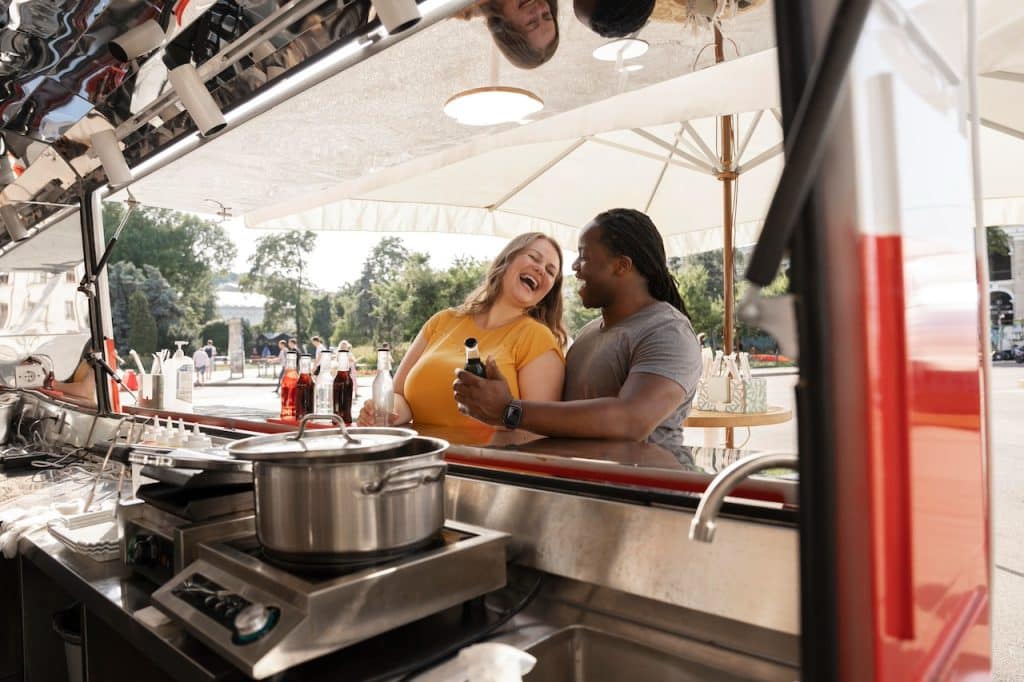
Starting a BBQ business from a concession trailer can be an attractive way to enter the food business without taking on the cost and fixed overhead of a traditional restaurant. A well-designed trailer can give you a commercial kitchen, smoker, refrigeration, prep space, serving window, storage, and the ability to take your business to different locations.
But BBQ trailers have one major difference from many other food trailers: the smoker can determine almost everything else about the design.
A burger trailer can be built around a griddle. A coffee trailer can be built around an espresso machine and refrigeration. A BBQ concession trailer has to accommodate large cuts of meat, long cooking times, smoke, heat, fuel, refrigeration, holding equipment, grease, wood or charcoal, and the workflow required to turn brisket, ribs, pork, chicken, and sausage into a fast-moving service.
That means the trailer should be designed around the way you actually intend to cook and sell BBQ—not the other way around.
Start With Your BBQ Concept
Before shopping for a trailer, decide what kind of BBQ operation you are building.
Your menu affects the smoker size, refrigeration requirements, prep counters, storage, cooking equipment, serving equipment, and even the amount of propane or electricity you need.
A trailer focused on brisket, pulled pork, ribs, and sausage will have different requirements from one selling grilled chicken, burgers, loaded fries, and BBQ sandwiches.
Start by answering a few basic questions:
- What meats will you sell?
- Will you cook everything from raw product?
- Will meat be smoked overnight or during the service day?
- Will you serve whole plates, sandwiches, combo meals, or all three?
- Will you sell sides such as mac and cheese, baked beans, slaw, and cornbread?
- Will customers order at the window?
- Will you cater private events?
- Will you operate at festivals, breweries, farmers markets, business parks, or permanent locations?
- How many meals do you expect to sell during a busy service?
The answers will give you a much better idea of what your concession trailer needs to accomplish.
A common mistake is designing the trailer around the equipment that looks impressive instead of the equipment that supports the menu.
A giant smoker may look like the heart of a BBQ business, but if it leaves you without enough refrigeration, prep space, dry storage, or room for staff to move, it can become an expensive bottleneck.
Choose the Right BBQ Smoker
The smoker is probably the most important equipment decision you will make.
There is no single “best” smoker for every BBQ concession trailer. The right choice depends on your cooking style, production volume, available fuel, local regulations, and how much labor you want to devote to tending the fire.
Common options include offset smokers, reverse-flow smokers, cabinet smokers, pellet smokers, and commercial gas-assisted smokers.
Offset Smokers
Traditional offset smokers are popular with pitmasters because they provide direct control over the fire and smoke.
They can produce excellent BBQ, particularly when the operator understands fire management. The drawback is that they require attention. Someone has to monitor the fire, maintain temperature, manage airflow, and add fuel.
That labor matters in a commercial operation.
If your brand is built around traditional wood-fired BBQ and the cooking process itself is part of your identity, an offset smoker may make sense. But make sure the trailer has adequate room for wood storage and safe access around the smoker.
Reverse-Flow Smokers
Reverse-flow designs are another option for operators who want traditional wood-fired cooking with more controlled heat distribution.
They can be particularly useful when consistency matters because the design is intended to direct heat and smoke through the cooking chamber before returning it toward the exhaust.
As with any smoker, however, capacity matters more than marketing claims. Look at the actual usable rack space and determine how many briskets, pork butts, racks of ribs, or chickens you can realistically cook in one batch.
Pellet Smokers
Pellet smokers can simplify temperature control and reduce some of the labor associated with managing a live wood fire.
That can be valuable when the same person needs to manage prep, service, inventory, and customer orders.
The trade-off is that you become dependent on electrical equipment and pellet fuel. Your trailer needs to be designed around adequate electrical capacity and reliable backup procedures.
Cabinet and Commercial Smokers
Cabinet-style smokers can provide substantial capacity in a relatively organized footprint.
For a high-volume trailer, vertical cooking space can be extremely valuable. You are trying to maximize production without consuming the entire floor plan.
When comparing smokers, don’t simply ask, “How many racks does it hold?”
Ask:
How many sellable portions can I produce per cooking cycle?
That is the number that matters to the business.
Size the Trailer Around Production
BBQ trailers commonly come in several lengths and configurations, but bigger is not automatically better.
A longer trailer costs more, weighs more, can be harder to tow, and may require a larger tow vehicle. It can also increase your maintenance and parking requirements.
At the same time, an undersized trailer creates problems that are difficult to fix later.
You need enough space for:
- Smoker
- Refrigeration
- Freezer space where required
- Prep tables
- Handwashing
- Warewashing
- Cooking equipment
- Hot holding
- Dry storage
- Ingredient storage
- Cleaning supplies
- Waste handling
- Point-of-sale equipment
- Employee movement
- Customer service
The layout should create a logical workflow.
Raw meat should enter the trailer, move into cold storage, proceed to preparation, then cooking, holding, slicing or portioning, and finally service.
The fewer times employees have to cross paths, the easier the trailer is to operate during a rush.
Don’t Buy the Trailer Before Checking Local Requirements
This is one of the most important steps in the entire process.
Do not purchase a trailer simply because the manufacturer says it is a “commercial food trailer.”
Your local health department, fire authority, building department, zoning authority, and other agencies may have requirements that affect the trailer’s construction and equipment.
The exact rules vary by location.
The FDA’s food establishment plan-review guidance emphasizes reviewing equipment locations and electrical, mechanical, and plumbing specifications before construction or purchase because problems are much easier to correct on paper than after a facility has been built.
That principle is particularly important with concession trailers.
Before placing a deposit, find out what your jurisdiction requires for:
- Food establishment licensing
- Mobile food unit permits
- Plan review
- Handwashing sinks
- Warewashing
- Fresh-water tanks
- Wastewater tanks
- Hot water
- Plumbing
- Electrical systems
- Refrigeration
- Ventilation
- Fire suppression
- Propane systems
- Fire extinguishers
- Smoker installation
- Grease management
- Commissary requirements
- Food storage
- Waste disposal
- Restroom access
- Parking and vending locations
The current FDA Food Code includes requirements concerning handwashing facilities and their convenient placement, but individual jurisdictions decide how the applicable food regulations are adopted and enforced.
The safest approach is to get your local requirements before you finalize the trailer design.
Design the Kitchen Workflow
A BBQ trailer can become surprisingly crowded.
Imagine a busy Saturday afternoon.
One employee is slicing brisket. Another is assembling sandwiches. A third is handling orders and payments. Someone needs to replenish sides. Another employee is washing equipment.
If the smoker door opens directly into the main employee pathway, the trailer becomes difficult to work in.
Think about the kitchen as a production line.
A practical workflow might look like:
Receiving → Refrigeration → Preparation → Smoker → Hot Holding → Cutting/Portioning → Assembly → Service
Try to keep clean and dirty tasks separated.
The handwashing station should be convenient rather than hidden behind equipment. Employees should not have to squeeze past a smoker or prep table every time they need to wash their hands.
Your trailer should also have enough working counter space for the final assembly of orders.
This is often overlooked.
Cooking capacity gets most of the attention, but the last 10 feet of the process—the point where cooked food becomes a completed order—can determine how quickly you serve customers.
Plan Your Refrigeration Carefully
Raw meat takes up a lot of space.
A BBQ business can burn through briskets, pork shoulders, ribs, chicken, sausage, butter, dairy products, sauces, vegetables, drinks, and prepared sides.
Don’t estimate refrigeration capacity based on what you need for a quiet Tuesday.
Plan for your busiest expected production day.
You also need to consider where raw and ready-to-eat products will be stored and how employees will access them without disrupting service.
A refrigerator that is technically large enough but difficult to access during a rush is not necessarily a good use of space.
Build Around Safe Food Handling
BBQ requires careful temperature control.
The smoker temperature and the internal temperature of the food are two different measurements. The USDA recommends using a thermometer to monitor the smoker and states that smoking meat and poultry should be performed while maintaining smoker temperatures between 225°F and 300°F.
You also need reliable food thermometers for checking product temperatures.
USDA guidance lists minimum internal temperatures of 145°F for whole cuts of beef, pork, lamb, and veal with a three-minute rest; 160°F for ground meats; and 165°F for poultry.
For cooked food being held for service, USDA guidance states that hot food should be held at or above 140°F.
These are food-safety benchmarks, not instructions for achieving the preferred BBQ texture. Brisket, pork shoulder, and ribs may require cooking well beyond their minimum safe temperatures to reach the tenderness and texture customers expect.
The important point is to separate food safety from pitmaster technique.
You need both.
Don’t Underestimate Hot Holding
A BBQ trailer isn’t finished when the smoker produces cooked meat.
You need a plan for what happens next.
Where will the brisket go?
Where will pulled pork be held?
How will sides stay hot?
How will you prevent food from drying out?
How much product should be held during the lunch rush?
Hot holding equipment can include steam tables, heated cabinets, holding ovens, and other commercial equipment approved for the application.
Your goal is to maintain quality while keeping food at safe holding temperatures.
USDA guidance identifies 40°F to 140°F as the temperature “Danger Zone” where bacteria can grow rapidly and recommends keeping cold food at or below 40°F and hot food at or above 140°F.
For a BBQ trailer, temperature logs and disciplined procedures are much more useful than relying on experience or appearance.
Think Seriously About Fuel
Your fuel choice affects trailer design.
Wood requires storage.
Charcoal requires storage.
Propane requires approved installation and storage.
Pellets require dry storage.
Electric equipment requires sufficient electrical capacity.
If you are running refrigeration, hot holding, lighting, POS equipment, water heating, ventilation, and cooking equipment at the same time, your electrical system needs to be designed for the actual load.
Don’t size a generator based solely on the smoker.
Calculate the combined electrical requirements of everything that might operate simultaneously.
The same principle applies to propane.
Have the system designed and installed according to applicable requirements rather than treating propane as an afterthought.
Decide How Much Food You Will Prepare Onboard
One of the biggest design questions is whether the trailer will function as a complete kitchen or as the final production and service point for food prepared elsewhere.
Some BBQ operators prepare everything on the trailer.
Others use a commissary or commercial kitchen for some preparation, storage, cleaning, or overnight cooking.
Your local regulations may influence what is allowed.
This decision can dramatically change the size and cost of the trailer.
If you can legally perform certain prep functions at an approved commissary, you may not need to dedicate trailer space to every piece of equipment required for full production.
But if your business depends on cooking all the meat from raw product on the trailer, the trailer needs enough capacity to support that operation.
Don’t Forget the Point of Sale
A BBQ trailer still needs a reliable way to take orders and payments.
A POS system can handle more than payment collection. It can organize menu items, modifiers, taxes, discounts, sales reporting, and inventory information depending on the system you choose.
Keep the POS station out of the way of food production.
The employee taking orders should be able to see the customer and operate the system without blocking the service window.
For a small trailer, a cloud-based POS can also be useful because sales information can be accessed away from the trailer when the system and internet connection support it.
The key is simplicity.
A BBQ customer does not want to spend five minutes navigating a complicated ordering screen while a line forms behind them.
Design the Menu for Speed
BBQ businesses can create enormous menus.
Brisket sandwiches.
Pulled pork sandwiches.
Ribs.
Chicken.
Sausage.
Platters.
Loaded potatoes.
Mac and cheese.
Beans.
Slaw.
Cornbread.
Desserts.
Drinks.
Then add combinations and substitutions.
Before long, the menu becomes difficult to execute.
A concession trailer benefits from a menu that uses the same core ingredients across multiple products.
For example, brisket can become a sandwich, platter, loaded fries, or baked potato topping.
Pulled pork can serve multiple menu formats.
The goal is not to make the menu boring. It is to make the operation efficient.
A smaller menu that you can execute consistently is usually easier to manage than a large menu that requires too many ingredients and preparation steps.
Calculate Your Capacity Before Choosing the Smoker
This is where many new BBQ operators make a costly mistake.
They buy a smoker based on its physical size instead of their sales forecast.
Suppose you expect to sell 150 meals during lunch.
How much cooked meat does that represent?
How much raw meat will you need?
How long does each product take to cook?
How much cooking capacity does your smoker have?
Can you cook enough product before service begins?
What happens if you sell out?
What happens if you have a 250-person event?
These questions should be answered before purchasing equipment.
A smoker that works beautifully for 75 customers may become a serious limitation at 200 customers.
Likewise, buying an enormous commercial smoker before you have the sales volume to justify it can tie up capital that would be better spent on refrigeration, a generator, POS equipment, branding, insurance, inventory, or working capital.
Choose the Tow Vehicle as Part of the Trailer
Don’t treat the tow vehicle as a separate decision.
The trailer’s loaded weight matters.
Once you add the smoker, propane, water, wastewater, refrigeration, food, equipment, utensils, staff supplies, wood, and other inventory, the trailer can weigh considerably more than its empty specification suggests.
You need a tow vehicle capable of safely handling the loaded trailer, including the appropriate towing capacity, hitch configuration, braking requirements, and payload considerations.
Also consider where you will store the trailer when it is not operating.
A BBQ trailer isn’t particularly useful if you cannot legally or practically park it at your home or business location.
Buy for Your First Real Volume, Not Your Fantasy Volume
It is tempting to build the biggest BBQ trailer possible.
A better approach is to design for the business you reasonably expect to operate in its early stages, while leaving room for growth.
Think about your first 12 to 24 months.
How many operating days will you have?
How many meals do you need to sell per day?
What average ticket are you targeting?
How many employees will work the trailer?
What percentage of sales will come from catering?
Will you operate lunch only, dinner only, or both?
Will you attend festivals?
Will you have a permanent location?
Those answers should drive your equipment list.
The best concession trailer isn’t necessarily the largest trailer or the one with the most equipment.
It is the trailer that allows your team to produce consistent food, move efficiently, maintain safe food temperatures, serve customers quickly, and make money without constantly fighting the physical limitations of the kitchen.
A Practical BBQ Concession Trailer Checklist
Before signing a purchase agreement, work through this checklist:
Trailer
- Appropriate size and weight
- Suitable tow vehicle
- Commercial-grade construction
- Adequate storage
- Service window
- Interior lighting
- Exterior lighting where required
Cooking
- Commercial smoker
- Backup cooking equipment where appropriate
- Food thermometers
- Adequate fuel storage
- Safe smoker access
- Ventilation and fire protection as required
Refrigeration
- Commercial refrigerator
- Freezer capacity if required
- Adequate cold storage for raw meat
- Space for prepared ingredients and sides
Preparation
- Stainless work surfaces
- Cutting boards
- Knife storage
- Ingredient storage
- Dedicated handwashing facility
- Warewashing equipment
Water and Waste
- Fresh-water capacity
- Wastewater capacity
- Water heater
- Appropriate plumbing
- Backflow protection where required
Service
- POS system
- Receipt printer if needed
- Menu board
- Food containers
- Packaging
- Utensils
- Condiments
- Napkins
Safety
- Fire extinguishers
- Required fire suppression
- Propane safety equipment
- Electrical protection
- First-aid supplies
- Cleaning and sanitizing supplies
Final Thoughts
Starting a BBQ concession trailer is not simply a matter of buying a trailer, putting a smoker inside it, and finding a busy parking lot.
The trailer is a compact commercial kitchen. Every square foot has a job.
The smoker needs enough capacity for your expected production. Refrigeration needs to support your purchasing and prep schedule. The plumbing has to work. Employees need a logical path through the kitchen. Hot holding needs to preserve quality while maintaining safe temperatures. Your electrical and fuel systems need to support the actual operating load.
Most importantly, the trailer needs to match your business model.
Before you buy anything, draw the workflow.
Put the smoker on the plan. Put the refrigerator on the plan. Add prep tables, sinks, hot holding, storage, POS, and service areas. Then imagine three employees working inside the trailer while 30 customers are waiting outside.
If someone has to reach across another employee to grab a pan, the layout needs work.
If the refrigerator door blocks the prep area, the layout needs work.
If the smoker prevents access to the service area, the layout needs work.
If there is nowhere to store a day’s worth of meat, sides, packaging, and supplies, the trailer is not ready.
The best BBQ concession trailer is designed around production, safety, workflow, and sales capacity rather than appearance alone.
Get those fundamentals right and the trailer becomes what it should be: a mobile BBQ kitchen that lets you take your food to the customers instead of waiting for customers to come to a permanent restaurant.


